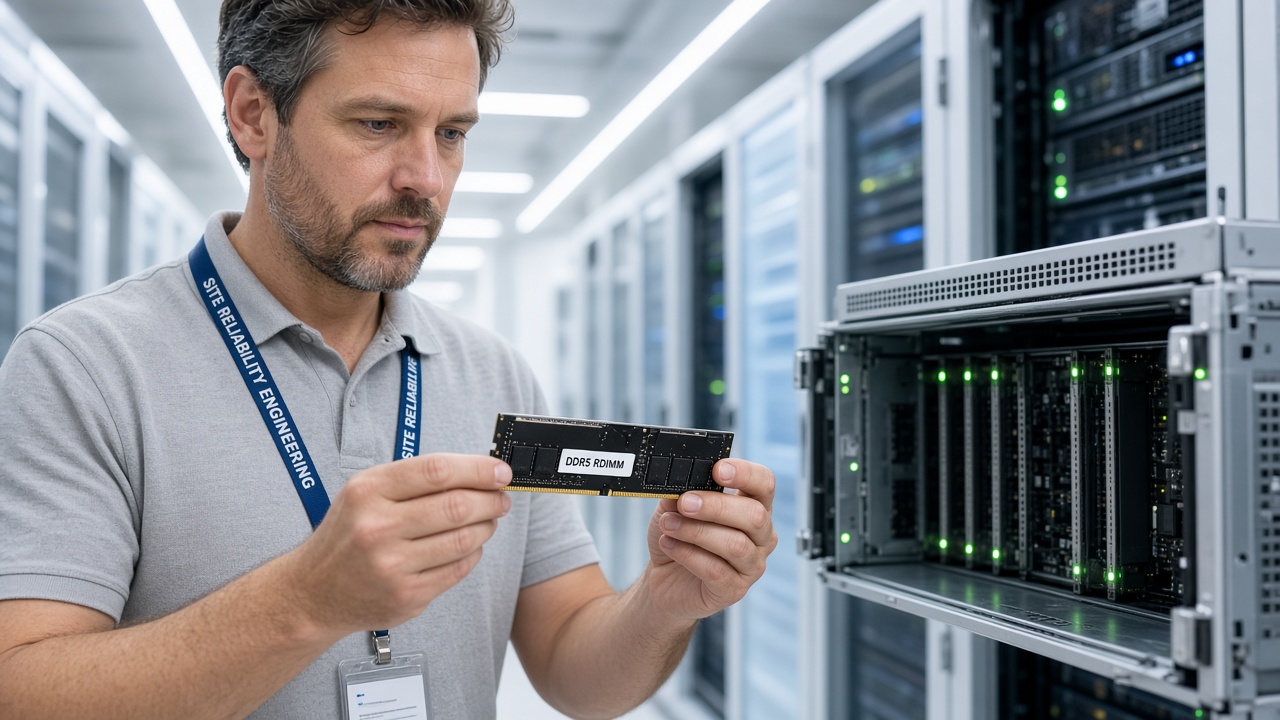
AI clusters do not only burn GPUs. They burn DDR5 on the host side — and server memory has been tight and expensive for anyone building or refreshing racks outside the biggest cloud budgets. That is the backdrop for a Chinese DRAM story that is easy to miss if you only read English wire copy.
On October 10 at China’s Fourth Integrated Chip and Chiplet Conference, Changxin Memory Technologies (CXMT / 长鑫存储) president Cao Kanyu said the company expects to launch a new-generation DDR5 RDIMM by end of 2026, built around its long-running 4F² DRAM cell architecture plus hybrid bonding and related process work. Chinese coverage from IT之家, 第一财经, and 科创板日报 all quote the same timeline; none of them list capacity, speed grade, power, or yield.
What “4F²” actually means
Mainstream DRAM cells today are typically 6F² — each bit cell occupies six times the square of the minimum feature size. 4F² shrinks that footprint, which in theory packs more bits per wafer. CXMT says it has pursued the design for years (300+ public patent families) and uses a vertical surrounded-gate (VSG) transistor plus a move toward 3D separation of array and peripheral logic via wafer-level hybrid bonding. That is a full process rewrite, not a drop-in shrink of a 6F² line.
The strategic choice matters more than the acronym: CXMT is aiming the first 4F² product at server RDIMM, not phones. Server modules must survive 24/7 duty, hot-plug stress, and long compatibility matrices across CPU platforms — a harder bar than consumer LPDDR.
Not as an end user yet. No module SKUs, samples, or qualified supplier lists were published with the talk. For overseas buyers the near-term path is indirect: watch whether OEMs and ODMs list CXMT DDR5 RDIMM on server BOMs in 2027. Counterpoint already put CXMT at roughly 7% of global DRAM revenue in Q2 2026 (fourth place) — mostly still skewed toward consumer, with server share growing from a smaller base.
Why overseas readers should care
- Supply diversity for AI hosts. Samsung, SK hynix, and Micron still dominate server DRAM. A fourth supplier that clears validation would not replace HBM, but it can ease DDR5 RDIMM tightness and pricing for everyone who buys racks.
- Density roadmap pressure. If 4F² delivers more bits per die after yield ramps, incumbent roadmaps feel competitive heat even if CXMT modules never ship to your address.
- What to verify, not celebrate. Spec sheets, JEDEC/platform quals, burn-in data, and real shipment volumes. A conference slide is a deadline, not inventory.
What it changes (if validation lands)
For a foreign cloud buyer, systems integrator, or AI lab: more qualified DDR5 channels mean better allocation and less single-region dependency for host memory. For Korean and U.S. DRAM investors, it is another signal that China’s memory stack is moving from phone-centric LPDDR toward the higher-margin server socket — the same direction CXMT’s G5 platform mass-production and earlier LPDDR6 claims already pointed at.
Keep the skepticism calibrated. MemoryTicker and Seoul-side commentary rightly note that public materials still do not prove mass yield or customer certification. End-2026 is a date to diary — then demand numbers.