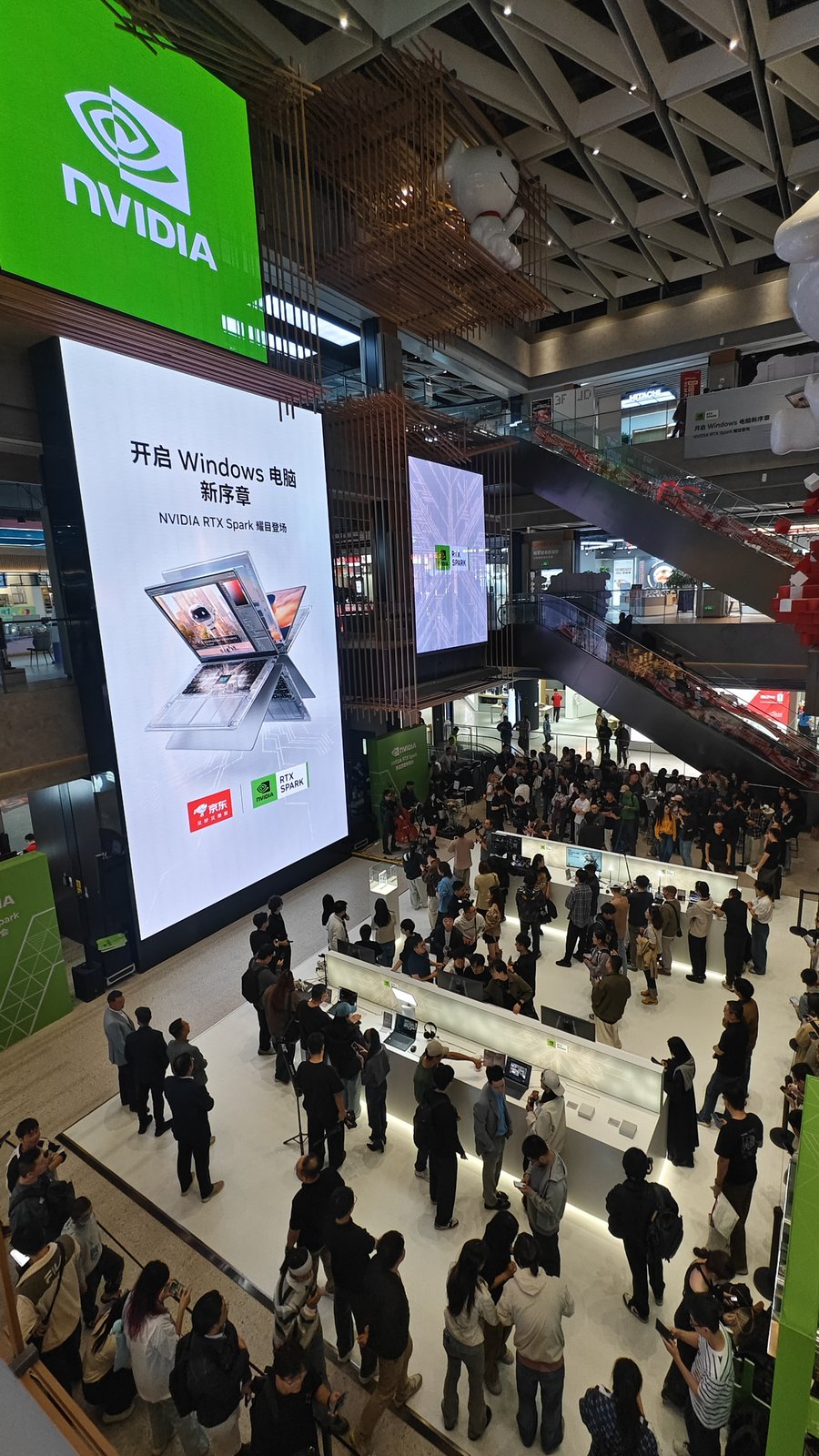
If you saw “Spark” and thought of NVIDIA’s palm-sized Linux AI workstation, pause. The product filling Beijing’s JD MALL 双井 tonight is RTX Spark — NVIDIA’s Grace + Blackwell N1 / N1X platform for Windows 11 on Arm thin notebooks and compact desktops. It is not a GeForce SKU nameplate, and it is not a rebadge of DGX Spark.
Friday, October 16 was the global retail kickoff. NVIDIA’s own launch invite lists six sister parties the same day — Beijing, Berlin, Istanbul, Seoul, San Francisco (Best Buy), and Taipei. In Beijing, check-in started at 19:00, the celebration at 20:00, demos through 21:30 local time at JD MALL Beijing Shuangjing (No. 31 Guangqu Road). Hands-on stations covered create / develop / game demos; the atrium LED and JD branding made the China channel story unmistakable.
What RTX Spark actually is
RTX Spark is a superchip platform OEMs put into finished PCs: MediaTek-collaborated N1X configs advertise up to a 20-core Grace CPU plus a cut-down Blackwell RTX GPU (vendor claims up to 6144 cores), unified LPDDR5X memory up to 128 GB, and roughly ~1 PFLOP FP4 local AI peak. The software story is the Windows stack — CUDA, DLSS, Reflex, Studio, Game Ready, plus Microsoft’s local-agent / MXC security path — in a backpack-friendly chassis, not a rack node.
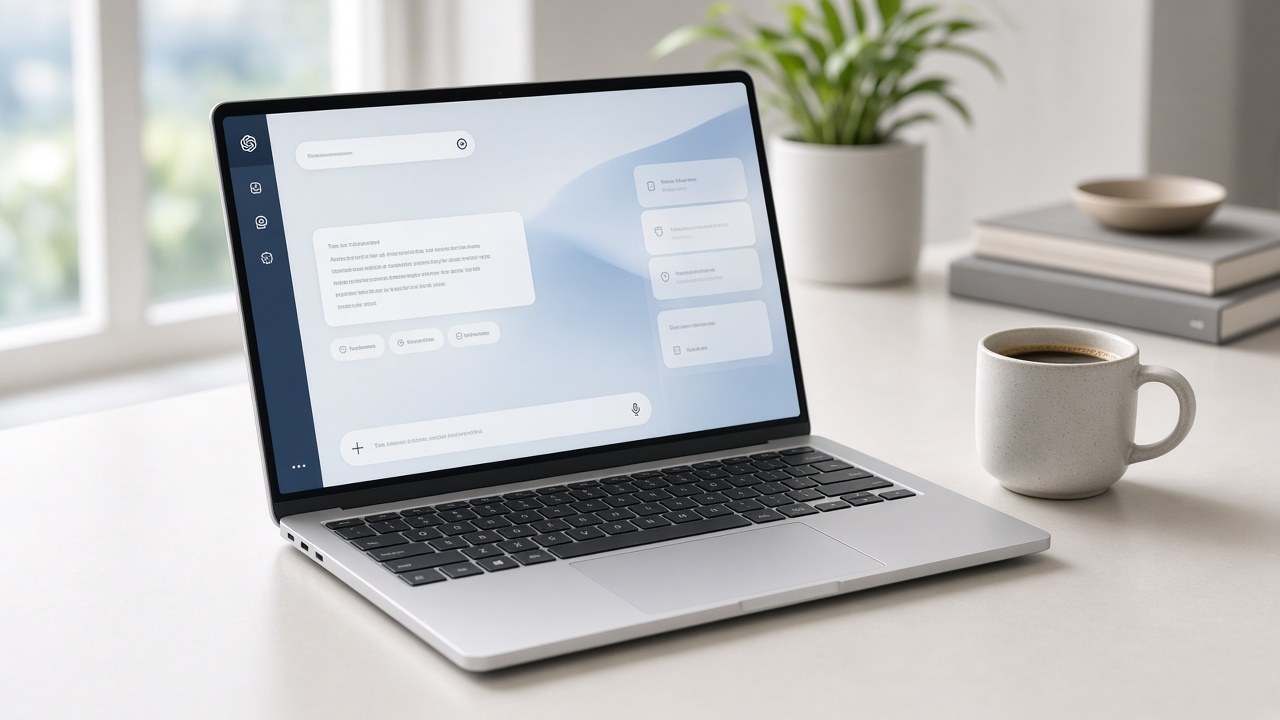
The form factor overseas readers should picture: a thin Windows AI / creator laptop, not a mini Linux developer box.
RTX Spark = OEM Windows 11 Arm laptops / compact desktops on the N1/N1X Grace-Blackwell platform. DGX Spark = NVIDIA-branded Linux DGX OS desktop AI box on related GB10 silicon, aimed at developers. Same family story, different OS, buyer, and retail aisle. Do not treat China edge boards marketed against DGX Spark as “RTX Spark rivals.”
Can overseas readers buy it?
Yes — this is a global launch, not a China-only SKU. U.S. retail (Best Buy / Amazon / OEM sites) lists first-wave configs from about $2,599 for entry Surface / ASUS ProArt builds; higher unified-memory configs climb into the mid-thousands, with top 128 GB notebooks quoted near $6,500–$7,000. Compact Windows mini-desktops for always-on agents are flagged for roughly November.
China’s JD channel opened the same day with OEM notebooks, per IT之家 price roundups:
- ASUS ProArt 创14 — from ¥18,999 (20C + 6144 + 32GB + 1TB); 128GB config ¥35,999
- Surface Laptop Ultra — from about ¥21,988
- Lenovo YOGA Pro 15 — from about ¥29,999
- MSI 尊爵 N16 Flip — top listing up to ¥45,999
The Beijing mall night is retail theater and channel proof — not a gray-market exclusive. If you want the Windows thin PC, buy local OEM retail; if you want the Linux developer box, that is still DGX Spark on separate listings.
Why the China scene matters for foreign readers
Three reasons, none of which require importing a JD-only chassis: (1) the naming collision with DGX Spark is already muddying English feeds; (2) Windows-on-Arm finally carrying a full CUDA/RTX local-AI claim is a platform shift you’ll meet at Best Buy the same week; (3) China’s atrium activation shows OEMs (ASUS, Lenovo, Microsoft, MSI, and more) shipping day-one SKUs into a major retail partner, not a paper launch.
Bottom line for overseas readers: the packed JD MALL floor is real, the product on the tables is a Windows AI laptop platform, and the box with ConnectX-7 stacking lore is a different Spark. Buy the one that matches your OS and job.