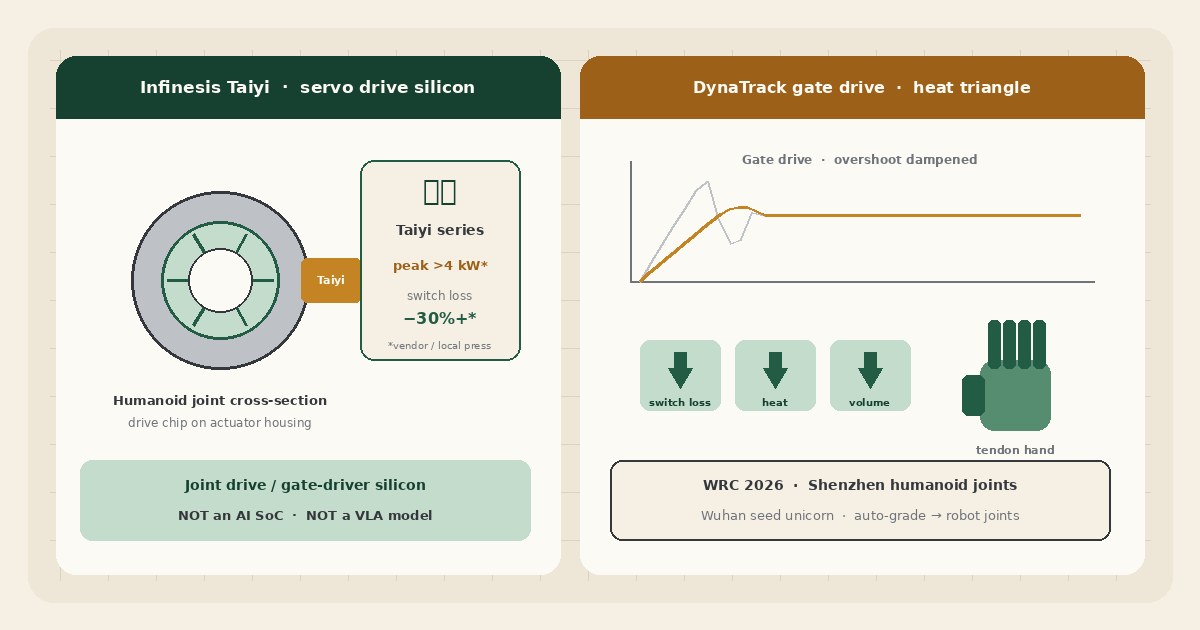
Humanoid joints are hitting a familiar hardware wall: enough peak torque and bandwidth for dynamic locomotion, without cooking the actuator or bloating the limb with heatsinks. Most of the overseas conversation still centers on motors, reducers, and torque sensors. Taiyi is a Chinese answer one layer down — a purpose-built servo drive / active gate-driver chip that tries to cut switching loss and voltage overshoot so the same joint envelope can push more power with less heat. If you design actuators or qualify Chinese humanoid supply chains, that is the part of the stack that matters here.
Who builds Taiyi
英弗耐思电子科技(武汉)有限公司 — English brand Infinesis, site invertnice.com — was founded in 2021 by Li Wei (李威), a Wuhan native with a PhD in intelligent robotics from Suzhou University and roughly 20 years in automotive electronics and chips. The company settled in the Wuhan Economic Development Zone in 2024 and was named a Wuhan “seed unicorn” in 2025. Local press describes successive A / A+ / A++ rounds involving Wuhan-linked funds, Bank of Communications AIC, and Dongfeng asset management, totaling nearly ¥100M by the A++ stage — treat fundraising detail as local reporting, not a filing.
Before the robot pivot, Infinesis’s commercial story was automotive: vendor and local-gov coverage say automotive-grade high-side driver chips shipped into about 500,000 NEVs, with body-domain controller wins at GAC, Dongfeng, Great Wall, and Shaanxi Auto, and roughly 500% CAGR over the last three years. That auto pedigree is the credibility hook for the joint-drive pitch — same founder, same gate-drive craft, new form factor.
Unclear from public materials. Taiyi is aimed at Chinese robot OEMs; the Shenzhen humanoid customer in the WRC piece is unnamed. Overseas path today looks like contact Infinesis (Wuhan phone / market email on invertnice.com) or watch which Chinese humanoid BOMs pick up the part — not a Digi-Key SKU or an open IP catalog. Plan evaluation around NDA samples and China supply-chain diligence, not a storefront order.
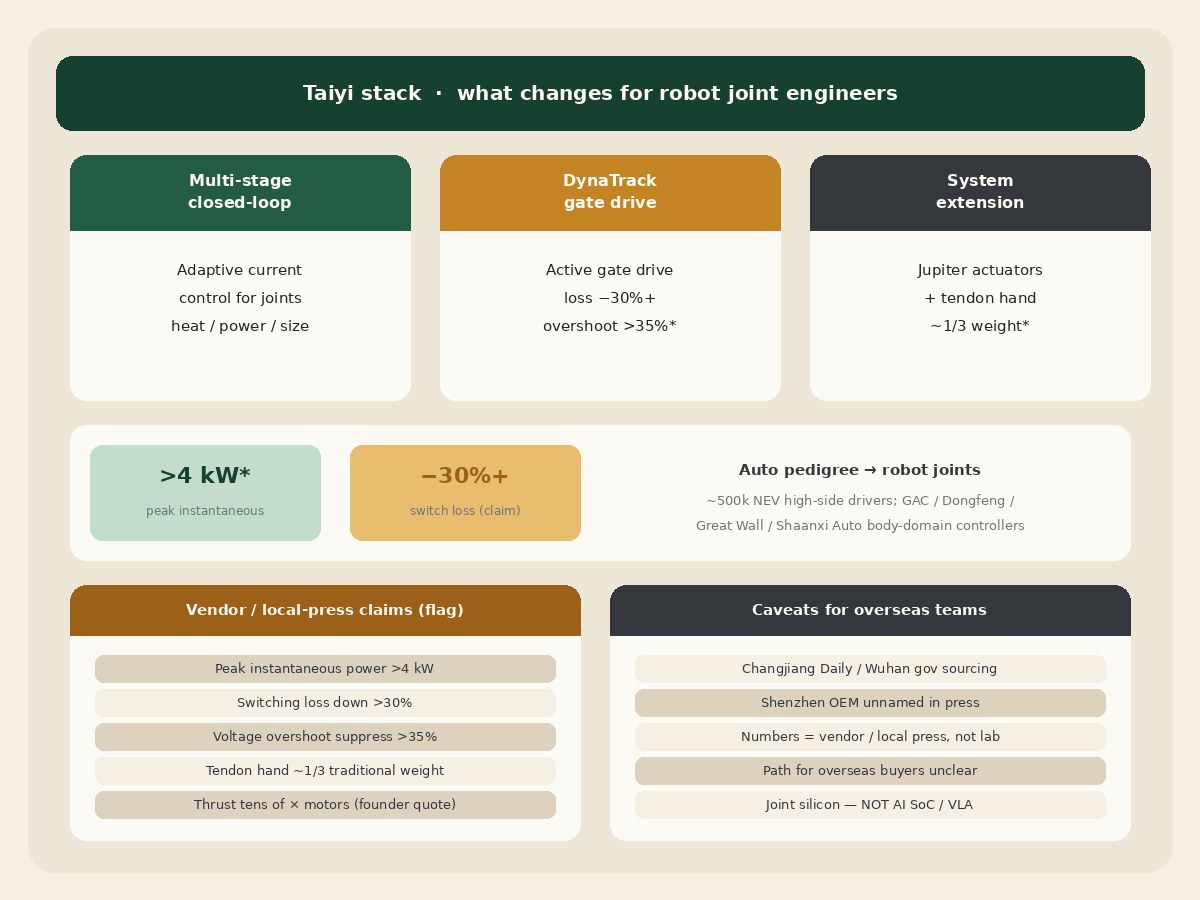
Closed-loop + DynaTrack + system products. Asterisked >4 kW / −30%+ / >35% overshoot / tendon-hand figures are vendor and local-press claims — not third-party lab benches.
What Taiyi claims to do
Local coverage (Wuhan Economic Development Zone republishing Changjiang Daily, plus Wuhan science and commerce bureaus) describes Taiyi as an intelligent servo drive chip for humanoid joints with:
- Peak instantaneous power >4 kW (vendor / local press).
- Switching loss down >30%; heat “significantly” lower (same sourcing).
- A multi-stage adaptive closed-loop control chip architecture aimed at the joint “heat / power / volume” trade-off the founder frames as an impossible triangle.
- Multi-stage DynaTrack / Dynatrack active gate-drive as the underlying IP — Infinesis’s site adds claims of voltage-overshoot suppression >35% and a “triple breakthrough” on loss, overshoot, and system efficiency. Label those as vendor marketing.
On the product site, Taiyi sits under a broader stack: high power-density servo drivers for embodied / surgical / inspection robots; Mars drone ESCs; Saturn wheel motors for AGV/AMR; Jupiter joint actuators for quadrupeds and humanoids. The chip is the claimed common substrate, not a one-off demo die.
WRC 2026 and the Shenzhen humanoid
The news hook is concrete but incomplete: a Shenzhen leading humanoid company put Taiyi into the joints of a new product that appeared at the 2026 World Robot Conference. The OEM is not named in the Wuhan/Changjiang pieces. For overseas readers that means you cannot yet map Taiyi to a public BOM or a known torque/thermal envelope — only that at least one high-profile Chinese humanoid program is willing to show the silicon in a conference demo.
Beyond the chip: direct-drive “artificial tendon”
Infinesis is also pitching a system-level extension: full direct-drive tendon products with no motor and no reducer. Coverage describes a dexterous hand at roughly one-third the weight of a traditional motorized hand, with >22 degrees of freedom. Founder Li Wei is quoted claiming thrust “tens of times” that of current motors via new material plus new drive tech — treat that as a founder claim, not a measured datasheet. It is directionally interesting for anyone tracking non-motor actuation in Chinese embodied AI, but it is a different product story from Taiyi silicon itself.
What actually changes
For overseas actuator and humanoid teams, Taiyi changes the Chinese supplier map more than it changes your next design review. You get a named Wuhan fabless with auto-grade high-side history, a public gate-drive story (DynaTrack), and evidence of at least one Shenzhen humanoid design-win shown at WRC 2026. That is useful competitive intelligence if you are qualifying Chinese joint modules, ESCs, or co-developing with a China OEM.
It does not give you a drop-in international catalog part, independent efficiency curves, or a clear export/support path. Software and control-loop integration will still be OEM-specific. And again: this is drive silicon — compare it to Infineon / TI / ST gate drivers and servo ICs, not to Rockchip NPUs or Nuclei RISC-V IP.
Honest caveats
- Local-gov / Changjiang Daily sourcing — primary narrative is Wuhan Economic Development Zone and related bureau reprints, not a peer-reviewed datasheet.
- Shenzhen OEM unnamed — WRC appearance confirmed in press; customer identity not disclosed.
- Performance numbers are vendor / local press — >4 kW peak, −30%+ switch loss, >35% overshoot suppress, tendon-hand weight/DoF, “tens of ×” thrust: all flagged claims.
- Overseas availability unclear — contact Infinesis / watch Chinese humanoid supply chains; do not assume global distribution.
- Category clarity — joint drive / gate-driver silicon, not an AI SoC or VLA model (distinct from today’s Nuclei NI1000 and Xijian Tianmou coverage).
Bottom line: Taiyi is a credible Chinese pitch that auto-grade gate-drive craft can migrate into humanoid joints, with a conference-visible design-win and a speculative tendon-hand follow-on. Overseas engineers should read it as supply-chain signal and a contact for China co-development — and stay skeptical of the loss and thrust multipliers until someone publishes independent actuator benches.