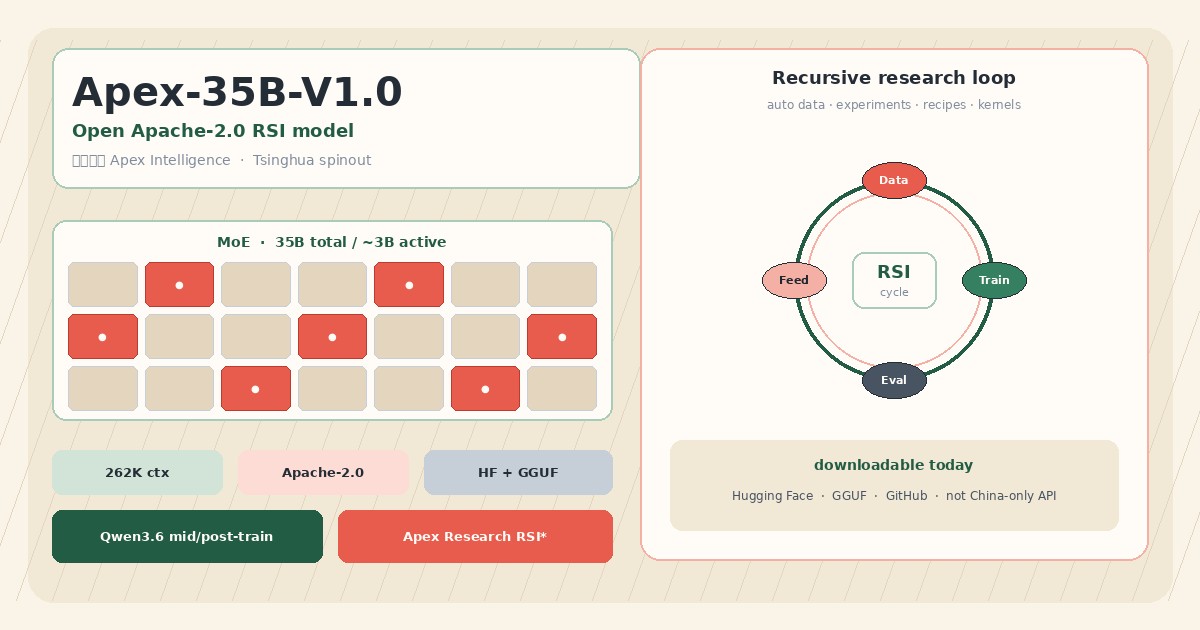
Most “China RSI” headlines still mean a closed API demo or a slide deck. Apex-35B-V1.0 is trying a different move: ship an Apache-2.0 MoE weight dump you can pull from Hugging Face the same day the Chinese press wave hits, then argue the training recipe itself is the product — an automated research agent that builds data, runs experiments, tunes recipes and kernels, and feeds validated results into the next cycle. That is a concrete engineering artifact, even if the RSI marketing is contested.
Who built it
Apex Intelligence (超衍智能) was founded around June 2026 by 陈勇超 (Chen Yongchao), a ~27-year-old assistant professor at Tsinghua’s AI School and reportedly the youngest there. Public contact listed on materials: [email protected]. Chinese press (机器之心 Pro, 虎嗅, 投中网) reports angel and angel+ rounds totaling roughly ¥4亿 (~$560M CNY) within months, with names such as IDG, 星连, 晶泰, plus Beijing / Shenzhen / Shanghai state capital — flag all of that as press claims*, not audited filings. The company site is apexin.com; the model tech post is at apexin.com/apex-35b/.
Yes, as downloadable weights. Hugging Face hosts the BF16 checkpoint (~72 GB) and a GGUF sibling (BF16 / Q8 / Q6 / Q5 / Q4). GitHub mirrors the release under apexin-ai/Apex-35B-V1.0. Serve with SGLang ≥0.5.22, vLLM ≥0.32, TokenSpeed, KTransformers, transformers serve, or llama.cpp — OpenAI-compatible endpoints. This is not a China-only API wall; you still need the GPUs (or a quantized local path) and you should use the model’s own chat_template.jinja.
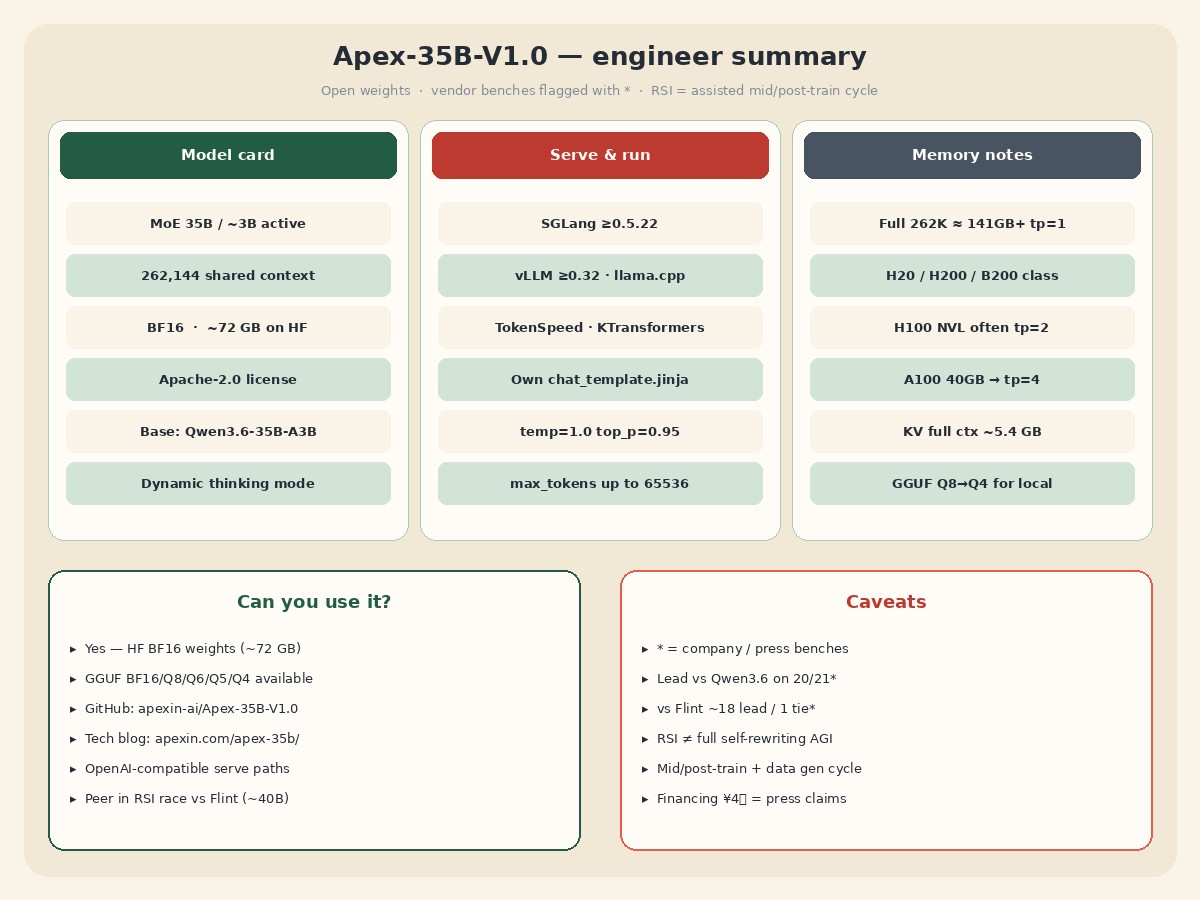
Three columns from the model card — architecture, serve path, memory — plus the practical “download it” checklist and asterisked vendor benches.
What the model is
On the card: MoE with 35B total parameters and roughly 3B active per token, BF16, and a shared input+output context of 262,144 tokens. License is Apache-2.0. The release mentions dynamic thinking — the chat template ends with a generation prompt that opens a thinking block, so harnesses that strip templates incorrectly will break the intended behavior. Recommended sampling from the card: temperature 1.0, top_p 0.95, top_k 20, max_tokens up to 65536.
Base lineage is further mid-training and post-training on Qwen3.6-35B-A3B, plus proprietary datasets and research trajectories. That matters for overseas readers already on the Qwen MoE family: this is not a from-scratch foundation model claim; it is a specialized continuation with an RSI-flavored data and recipe loop on top.
What “RSI” means here
Apex brands the loop as Apex Research: automated data construction, experiment design, training-recipe search, GPU kernel work, and inference optimization, with validated results feeding the next cycle. Claude Code–style harness usage shows up in the Chinese coverage as part of the agent tooling story. Read that carefully. This is mid/post-train RSI assistance and synthetic data generation — not a claim that the model rewrites its own architecture into AGI overnight. RSI marketing across the industry is contested; company claims are not an independent audit. Position it as a downloadable peer in the same race as Recursive Superintelligence’s Flint (~40B class), not as proof that the full self-improving loop is solved.
Serve path and memory
Primary weights: huggingface.co/Apexintelligence-AI/Apex-35B-V1.0 (~72 GB BF16). Quantized / GGUF: …/Apex-35B-V1.0-GGUF. Code: github.com/apexin-ai/Apex-35B-V1.0.
Memory notes from the Hugging Face card (plan around these, do not treat as a FLOP guarantee): full 262K context needs on the order of ~141 GB+ GPU for tensor-parallel size 1 (H20-3e / H200 / B200 class); H100 NVL setups often want tp=2; A100 40GB often tp=4. KV cache for the full context is quoted around ~5.4 GB. For local boxes, the GGUF ladder (Q8 → Q4) is the practical on-ramp; keep the model’s chat template intact so thinking mode still fires.
Vendor benches (flag every number)
Company tables circulating with the Oct 28–29 press wave claim Apex-35B leads Qwen3.6-35B-A3B on 20 of 21 reported comparisons*, and against Recursive Flint (~40B) roughly 18 leads / 1 tie*. Standouts they highlight include SciCode 62.6 / 75.6*, SWE-bench Pro v2 92.4*, BFCL V4 84.0*, BrowseComp 69.4*, AutomationBench 49.3*, RoboRSI 44.5*, Real2Sim 21.6*, and CFD-Bench 79W / 0D / 21L vs Qwen*. They also show selective wins and losses against much larger GLM / DeepSeek-class models — do not read that as “beats 500B / 800B overall.” Asterisk everything until third parties rerun the suites with fixed harnesses.
The interesting signal for overseas labs is less the absolute scores and more the domain mix: science coding, agent / tool use, browsing, robotics simulation, and CFD-style scientific workloads sit next to conventional SWE and function-calling benches. That matches the Apex Research pitch — research agents feeding specialized trajectories — better than a generic chatbot dump.
What changes
If you already evaluate open MoE mid-sizes (Qwen3.x A3B-class, peer RSI weights such as Flint), Apex-35B is another Apache-2.0 checkpoint you can put on the same SGLang / vLLM / llama.cpp rack today, with a long context window and an explicit thinking template. For agent and science-sim teams, the RoboRSI / Real2Sim / CFD-Bench emphasis is the differentiator to test — not the funding headlines. For China-watchers tracking the RSI narrative, it is one of the few times the marketing dump includes a same-day Hugging Face mirror instead of a waitlist.
It does not replace a frontier closed API, a verified independent eval suite, or a claim that recursive self-improvement is “solved.” Keep it distinct from other ChinaHotTech coverage this week: RLinf v0.4 is embodied RL infrastructure (different company), Nanbeige4.3-33B / MiniMax M3.1 / Kimi K3.1 are separate model stories, and chip posts (Nuclei, Tianmou, RK1828) are unrelated silicon.
Caveats
- Asterisk every vendor % — SciCode, SWE-bench Pro v2, BFCL, BrowseComp, AutomationBench, RoboRSI, Real2Sim, CFD-Bench, and head-to-head vs Qwen / Flint / large GLM·DeepSeek are company tables*.
- RSI definition — assisted mid/post-train + auto data / recipe / kernel loop; not a audited self-rewriting AGI system.
- Financing — ~¥4亿 angel+ stack and named LPs are press reports*, not confirmed SEC-style disclosures.
- Base is Qwen3.6-35B-A3B — credit the lineage; do not market as a from-scratch 35B foundation.
- Memory is real — full 262K wants multi-hundred-GB class GPUs at tp=1; plan tp or GGUF for smaller boxes.
- Use the shipped chat template — thinking mode depends on it; wrong templating silently degrades quality.
Bottom line: Apex-35B-V1.0 is a downloadable Apache-2.0 MoE with a long context window and an RSI-flavored research loop story — usable overseas today via Hugging Face and GGUF, interesting as a peer to Flint-class open RSI weights, and honest only if you keep the asterisks on the benches and the humility on what “recursive self-improvement” currently means in practice.