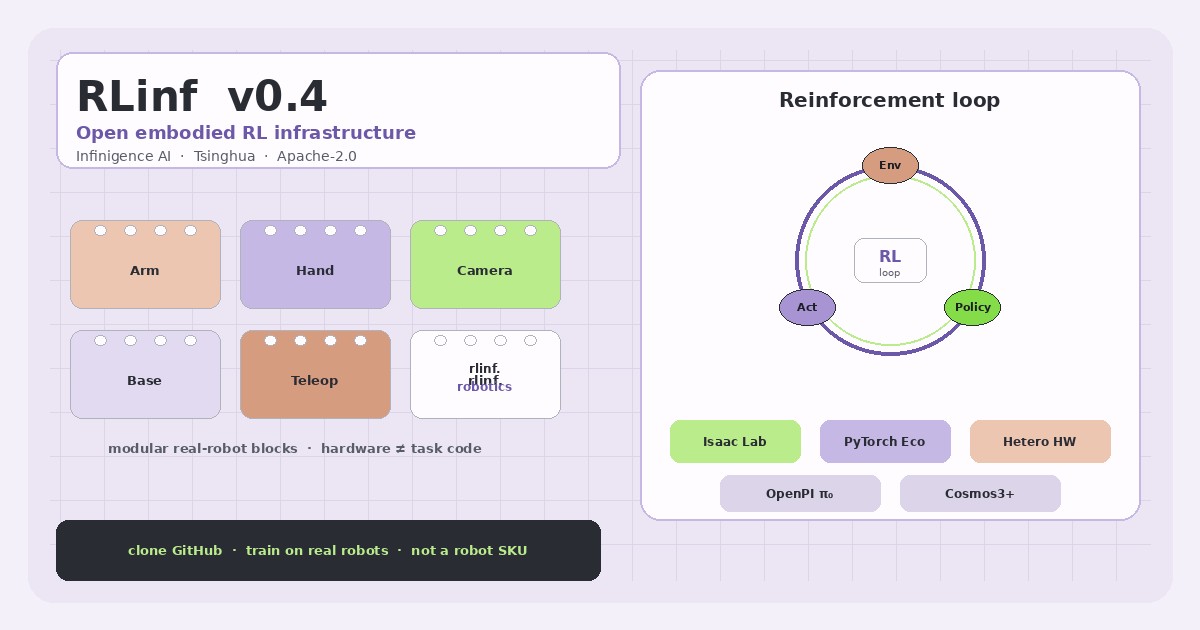
Most “embodied RL” headlines still mean a paper, a closed stack, or a simulator demo that never leaves the lab. RLinf v0.4 is trying to be the opposite: a cloneable PyTorch training stack with a modular real-robot API, recipes that span sim and Franka-class hardware, and enough ecosystem hooks that overseas teams can actually try it — including as the RL post-training engine inside NVIDIA Isaac Lab v3.0.
What it is
RLinf (GitHub org/repo RLinf/RLinf) describes itself as reinforcement learning infrastructure for embodied and agentic AI. The English docs live at rlinf.readthedocs.io; Chinese release notes mirror the same v0.4 story. License is Apache-2.0. Default runtime for this release moves to PyTorch 2.11 with matching SGLang / vLLM pins — the upgrade notes say do not reuse a v0.3 venv; rebuild via requirements/install.sh or the rlinf0.4 Docker images.
Where v0.3 focused on connecting simulation to real robots, v0.4 frames three pillars: a Lego-style real-robot system, high-efficiency real-robot algorithms, and full-modality models on a heterogeneous compute base. RLinf is listed in the PyTorch Ecosystem, and Isaac Lab’s own docs document RL fine-tuning of VLAs (GR00T, OpenVLA, and related) with --rl_library rlinf.
Yes, as software. Clone the Apache-2.0 repo, follow the English install / example docs, or use the Isaac Lab v3.0 RLinf path for VLA post-training on Linux. You still need GPUs (or other supported accelerators), robot access or a sim suite such as LIBERO / ManiSkill / Isaac Lab, and patience for bring-up. There is no retail robot SKU attached to this release.
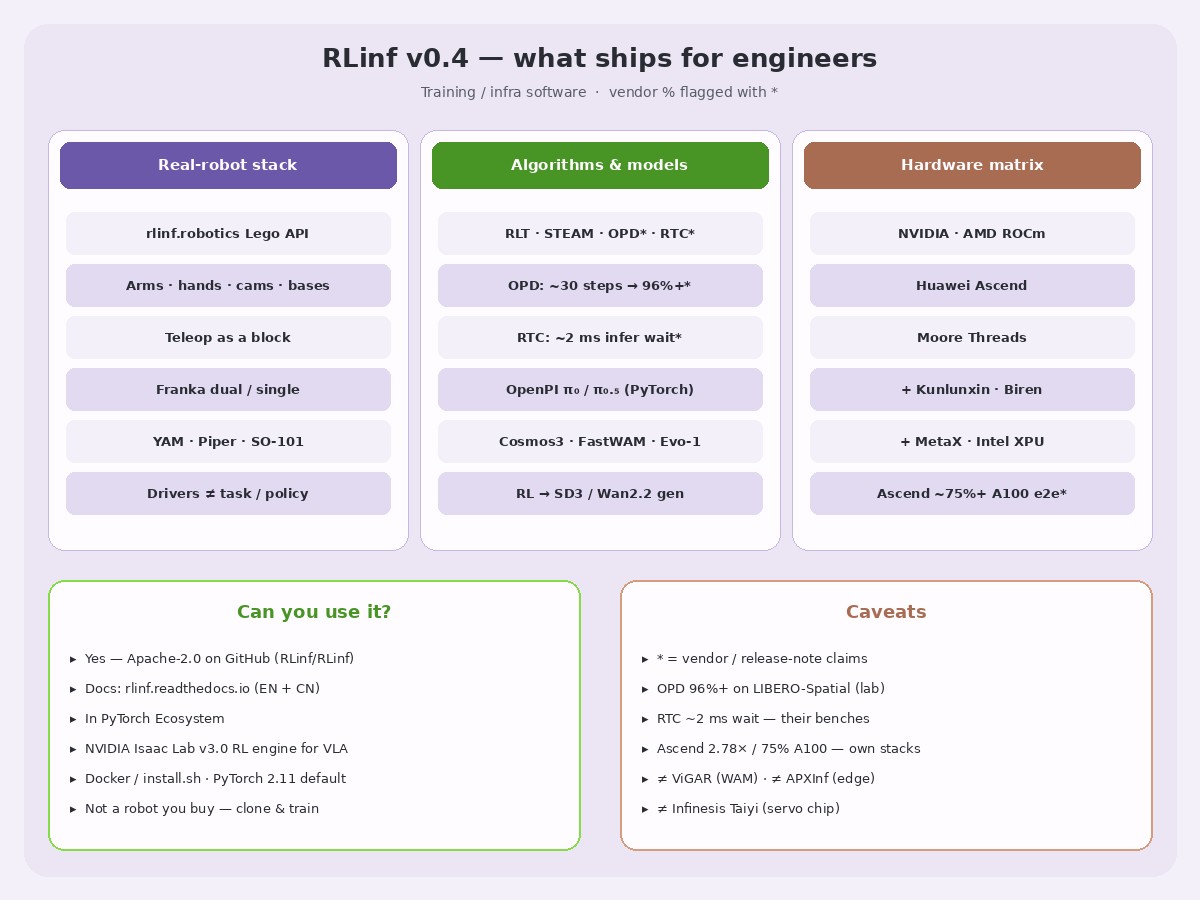
Three columns from the release notes — real-robot API, algorithms/models, hardware matrix — plus the practical “clone it” path and asterisked vendor benches.
Real-robot stack
The headline engineering change is rlinf.robotics: arms, dexterous hands / grippers, multi-view cameras, mobile bases, and teleoperation devices are treated as composable blocks. Hardware drivers are decoupled from task definitions and environment wrappers, so swapping a body, a config, or a cross-node layout should not force rewrites of task or policy code. Older paths under rlinf.envs.realworld / hardware robot schedulers migrate into this module and rlinf.envs.real.
Platforms called out in the release: dual-arm and single-arm Franka toolchains (PICO VR teleop, HG-DAgger, OpenPI π₀.₅ SFT/deploy, Qwen-VL reward model, LeRobot dataset tooling), plus dual-arm YAM, AgileX Piper, and SO-101. That is still a research/lab footprint — not a claim that every warehouse robot plugs in overnight — but it is unusually concrete for an open Chinese RL infra release.
Algorithms and models
v0.4 ships several real-robot-oriented algorithms. Treat the success and latency numbers as vendor / release-note results* until you reproduce them:
- RLT (RL Token) — two-stage online RL that decouples high-dimensional visual features from control; stage 2 trains a lightweight off-policy actor-critic (including a TD3 variant) on a frozen compact representation.
- STEAM — self-supervised offline advantage modeling from demonstration video frame order, without hand labels or online interaction; release notes claim it beats RECAP on tasks such as bimanual towel folding and restocking*.
- OPD (On-Policy Distillation) — student rollouts with dense teacher scoring on action tokens. On LIBERO-Spatial, the notes claim ~30 training steps lift an OpenVLA-OFT student from 67% to 96%+ success*.
- RTC (Real-Time Control) — overlaps next-chunk inference with current-chunk execution; claimed rollout inference wait down to about 2 ms*, with episode time cuts up to ~7.4 s* on their benches (LIBERO + real Franka).
Model coverage expands around a PyTorch-native OpenPI (π₀ / π₀.₅) rewrite aligned operator-by-operator to the official JAX reference, plus NVIDIA Cosmos3, FastWAM, π₀-FAST, Evo-1, and MolmoAct2. RL also stretches into diffusion generation via Diffusion-NFT for SD3 and Wan2.2 (including TI2V-5B), with OCR-style rewards in the examples. Agentic / reasoning recipes (e.g. Moonlight-16B GRPO, SearchR1 FSDP) sit in the same release tree.
Hardware matrix
Beyond NVIDIA, the stack lists AMD ROCm, Huawei Ascend, Moore Threads, and newly called-out Kunlunxin, Biren, MetaX (沐曦), and Intel XPU. Ascend notes claim end-to-end compute efficiency at ~75%+ of A100* across about ten embodied models on Ascend 910B3, plus throughput gains up to about 2.78×* on some GR00T / StarVLA stacks via fused ops and prefetch overlap. Moore Threads S5000 notes describe WoVR RL closed-loop curves correlating closely with A100 on LIBERO*. All of that is first-party measurement on their configs — useful as a shopping hint for China-side clusters, not as a portable FLOP guarantee.
What changes
For overseas embodied / VLA teams, the practical delta is less “another Chinese paper” and more “a maintained training engine with an Isaac Lab on-ramp.” If you already collect demos and SFT a VLA, RLinf is one open path to PPO / actor-critic / SAC-style fine-tuning with FSDP and documented Hydra YAMLs. The modular robot API matters if you bounce between Franka, Piper-class arms, and sim without forking the whole stack. Heterogeneous accelerator support matters most for labs that must train on Ascend or ROCm rather than only A100/H100.
It does not replace a robot policy product, a teleop fleet, or a closed commercial VLA API. Bring-up cost remains real: matching Isaac Lab / GR00T pins, Ray workers, and checkpoint formats takes engineering time. Keep it distinct from related-but-different ChinaHotTech coverage: ViGAR is a world-action model for humanoids; APXInf is an edge inference engine that appears as an eval backend here — not the same story; Infinesis Taiyi is a servo/gate-driver chip from a different company.
Caveats
- Asterisk every vendor % — OPD 96%+, RTC ~2 ms, Ascend ~75% A100 / up to ~2.78×, STEAM vs RECAP wins are release-note / partner benches, not third-party audits.
- Infra, not a robot SKU — overseas path is GitHub + docs + Isaac Lab; plan GPUs and lab robots yourself.
- Breaking upgrade from v0.3 — new robotics module paths, OpenPI checkpoint conversion, PyTorch 2.11 default.
- Chinese press lag — GitHub tag ~20 Oct 2026; broader CN coverage ~28 Oct does not change the engineering artifact.
- Do not conflate brands — Infinigence AI / 无问芯穹 / Infini-AI for this stack; not Infinesis, not ViGAR, not APXInf-as-primary.
Bottom line: RLinf v0.4 is one of the more usable open embodied-RL infrastructures coming out of the China + Tsinghua orbit — Apache-licensed, documented in English, wired into Isaac Lab, and honest enough in its release notes that you can see which numbers are their own. Clone it if you train VLAs; skip the hype if you were hoping for a robot in a box.