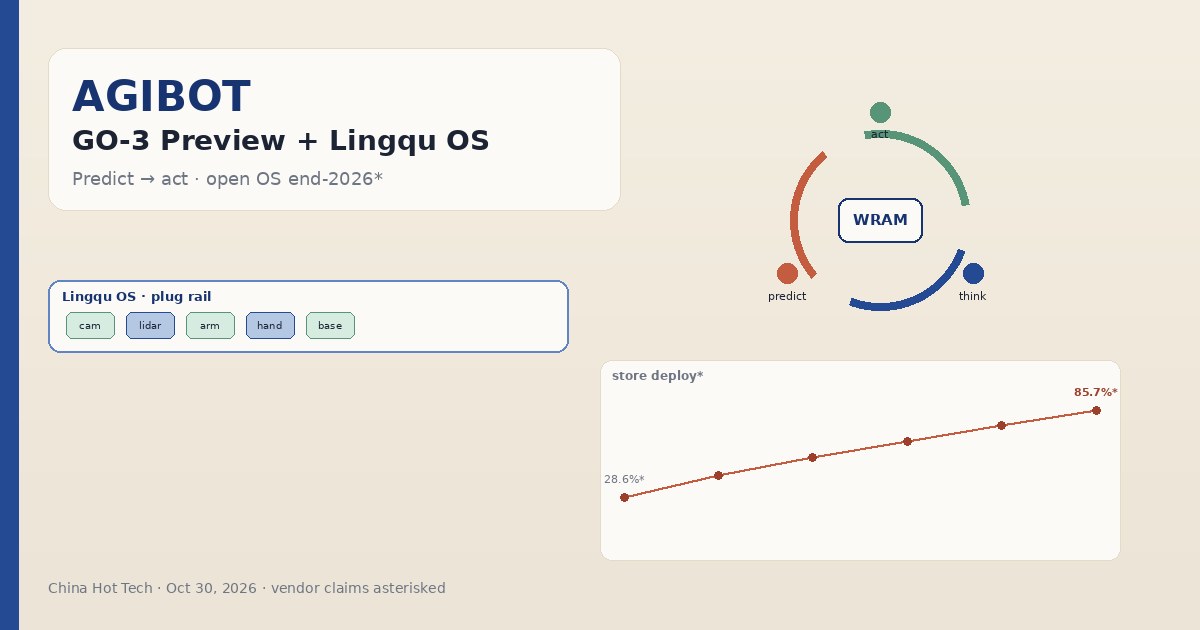
Chinese humanoid coverage still loves parkour clips. AGIBOT’s A.I.DAY deliberately did the opposite: a dense stack dump aimed at putting robots on real jobs rather than more backflips. Co-founder / CTO Peng Zhihui framed it as: shipping ten thousand units is a manufacturing win; keeping ten thousand useful on shift is the physical-AI win. That is the overseas-relevant pitch: software that keeps improving after the robot is already in a store or factory, plus an OS they say they will open.
GO-3 Preview: reason, predict, then act
GO-3 Preview is AGIBOT’s embodied base model built around WRAM (World Reasoning Action Model) — one pipeline that ties task reasoning, future prediction, and action generation. The company says it recently topped RoboDojo, RoboTwin, and RoboColiseum*, and that a full open-source release is planned for the end of 2026*. Pretraining mixes human first-person video with robot trajectories so the model can transfer across home, kitchen, multi-robot, and dexterous settings in zero-shot and few-shot regimes*. Long-horizon demos in Chinese press include making jianbing and Lego-style assembly after light fine-tuning*. Treat the leaderboard crowns and demo menus as vendor theater until you see public eval logs.
Post-training uses Genie Evolver — a distributed mix of roughly 100 real robots*, simulation, and world models. Press color: after about four hours of online iteration on table curling, the robot beat a measured human average*; on a Jenga-style tower it pulled five blocks while keeping the stack stable*. Deploy-time learning is the part that travels: Genie Master is the embodied agent framework that closes the loop of judge → execute → feedback on the job. On a convenience-store G2, AGIBOT claims full-task success rose from 28.6% to 85.7%* over five days with no human demonstration or debug*, and single-task success beat ordinary SFT by 17.7 percentage points* while continuing online learning instead of plateauing*. If even half of that holds under third-party logging, it is a stronger signal than another parkour reel.
Not as a download. GO-3 weights and Lingqu OS are still inside AGIBOT’s closed stack. The actionable overseas path is the end-2026* open-source calendar (GO-3 Preview + Lingqu OS via OpenAtom) and watching for public repos / packages when that dump lands. This is not a Digi-Key board, not a Hugging Face weight drop tonight, and not a substitute for buying a G2. Keep it distinct from our earlier AgiBot G2 Max hardware post — that was a product SKU; this is the model + OS story.
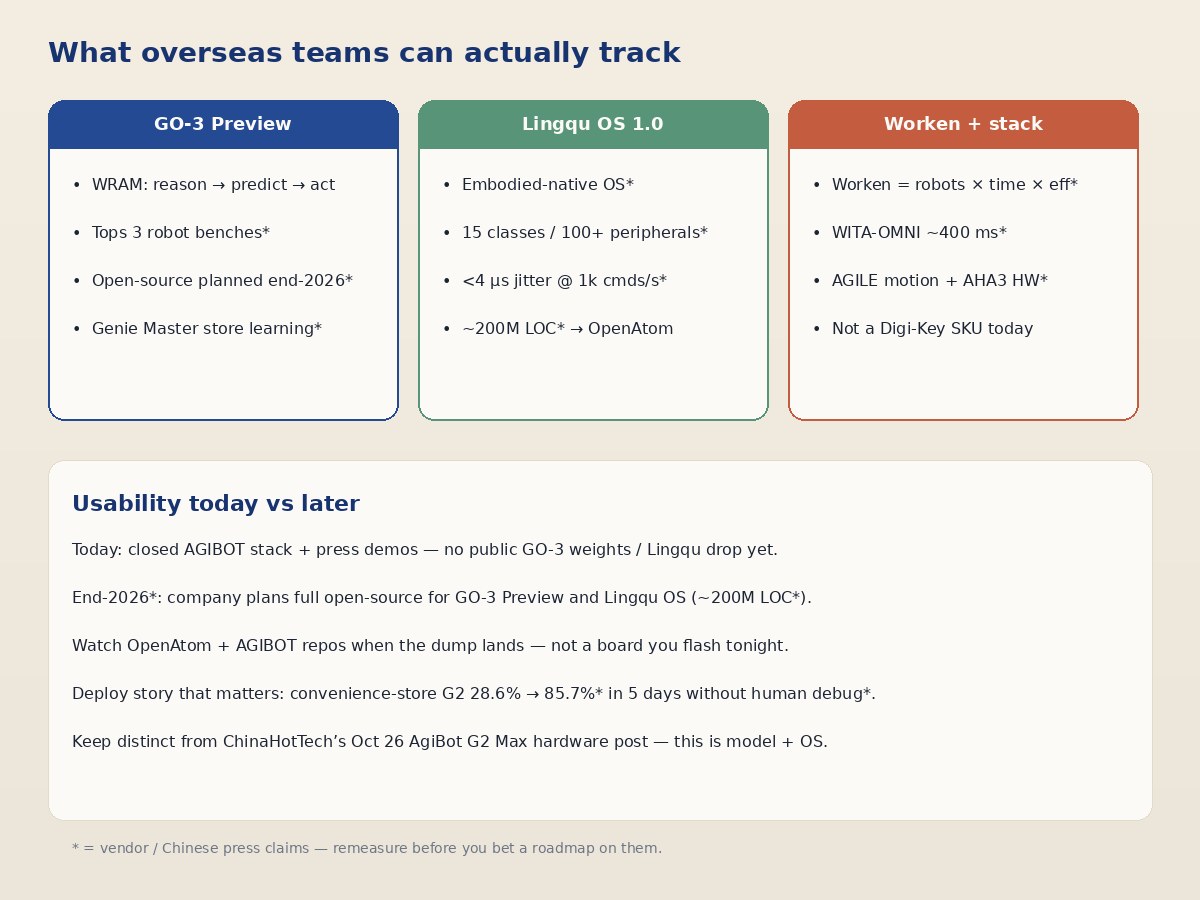
Three columns — GO-3*, Lingqu OS*, Worken + stack* — plus what is usable today versus what waits on the end-2026* open-source plan.
Lingqu OS 1.0: the glue they want to open
Lingqu OS 1.0 is pitched as an embodied-native operating system that unifies hardware, communications, and the three intelligences (task, motion, interaction). Engineer-facing claims*: USB-like plug-and-play for 15 device classes and 100+ peripherals*; motion command streams at 1000 cmds/s with interval error under 4 µs*. AGIBOT says it will donate the project to the OpenAtom foundation and fully open-source by end of 2026* — roughly 200 million lines* of production-validated code and 5000+ ecosystem packages*. Those LOC and package counts are press figures; wait for the actual tree and license before you plan a fork.
Around the OS, A.I.DAY also showed WITA-OMNI (full-duplex multimodal interaction; fastest response about 400 ms*, average about 600 ms*; wake-word-free claims; language/dialect counts differ by outlet — treat as vendor*), AGILE for general motion intelligence, and AHA3 third-generation hardware architecture (control volume roughly halved*, response roughly doubled*). Useful context, but secondary to GO-3 + Lingqu for anyone waiting on open code.
Worken: a physical-AI productivity unit
AGIBOT floated Worken as a productivity metric for physical AI — active robots × autonomous work time × output-efficiency ratio, with a skilled human’s unit output defined as 1.0*. Think of it as their attempt at a “token” for labor in the real world. Whether customers ever buy Worken packages instead of robot SKUs is speculative; the interesting part is that a Chinese humanoid vendor is trying to productize measured on-job output rather than peak demo difficulty.
What changes
For teams tracking Chinese embodied AI, this A.I.DAY package is a shift from “watch the flip” to “watch the learning curve after install.” GO-3’s WRAM framing (predict consequences before acting) plus Genie Master’s claimed five-day store climb is the research signal; Lingqu’s OpenAtom / end-2026* open-source plan is the software signal. Business color from the same event*: H1 2026 revenue near RMB 2B*, roughly 20,000 general AI robots off the line*, plus deploy anecdotes at factories, theme parks, and retail — interesting for market sizing, not proof of Worken math.
It does not hand you weights, an OS tarball, or an independent store audit today. Keep branding clean: AGIBOT GO-3 Preview + Lingqu OS — separate from G2 Max hardware, from RLinf training infra, and from other ChinaHotTech silicon posts.
Caveats
- Asterisk every vendor % — bench tops, 28.6% to 85.7%*, +17.7 pp vs SFT*, 400 ms*, under 4 µs*, volume/response deltas*, language counts.
- Open-source is a plan, not a drop — end-2026* for GO-3 and Lingqu; ~200M LOC* / 5000 packages* are press claims.
- Closed today — no public weights / OS tarball / Digi-Key path claimed.
- Not G2 Max — prior ChinaHotTech post covered the hardware SKU; this is model + OS.
- Worken — conceptual metric; no evidence yet that buyers procure against it.
- Revenue / shipment color* — H1 ~RMB 2B*, ~20k units* from company remarks via press.
Bottom line: AGIBOT’s A.I.DAY package is a deploy-time learning and embodied-OS story with a dated open-source promise — relevant for robotics engineers and PMs watching Chinese stacks, usable overseas only when the end-2026* dumps appear, and honest only if you keep the asterisks on the store curve and the bench crowns.