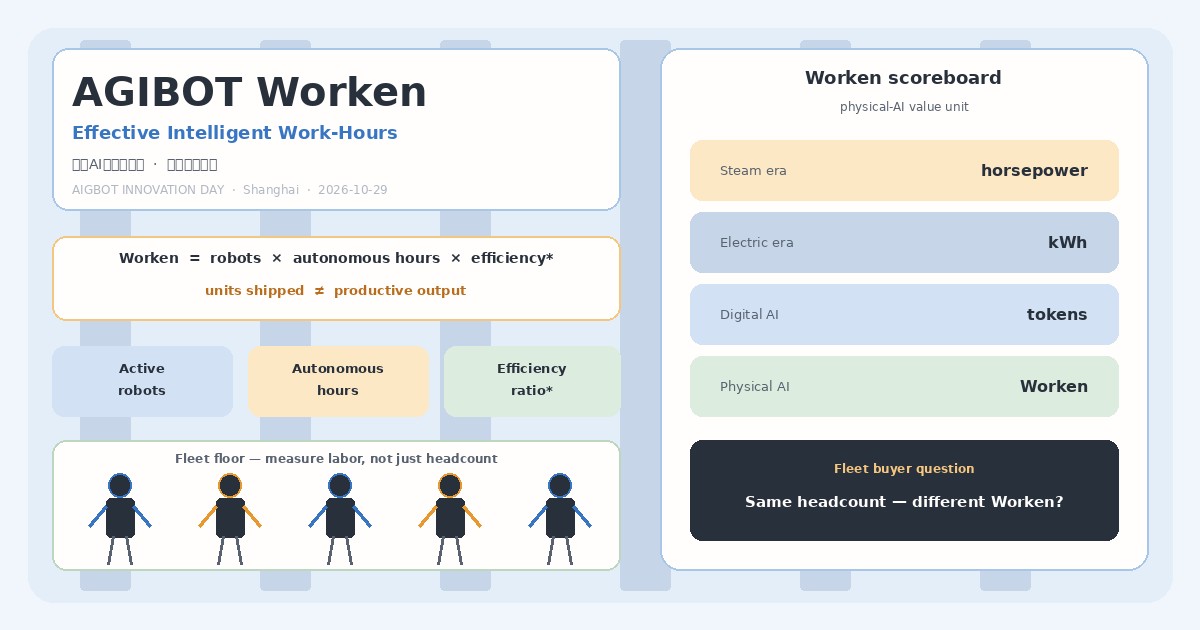
If you buy or operate robot fleets, the spreadsheet that still starts with “how many units did we ship / install?” is the wrong first column. A humanoid that sits in a crate, waits for a teleoperator, or fails mid-cycle is not delivering the same labor as one that runs unsupervised for a shift. Worken is AGIBOT’s attempt to name that gap — a single number meant to sit next to horsepower, kilowatt-hours, and tokens as the physical-AI era’s unit of machine value.
What Worken is
Peng’s on-stage framing borrowed the usual industrial analogies: steam-era horsepower, electric-era kWh, digital-AI tokens — and for embodied / physical AI, Worken. The disclosed formula is multiplicative:
- Active robot count — how many machines are actually in productive service
- × autonomous work hours — time spent working without continuous human teleop
- × output efficiency ratio — a scalar for how much useful output those hours produce*
Chinese coverage quotes Peng on the practical distinction: a robot powered on for eight hours has not automatically created eight hours of value, and a high one-shot task success rate does not prove the machine can hold a month of continuous, stable work. Worken is designed to push the conversation from a parameter sheet toward a work-hours sheet.
As a procurement and RaaS framing tool — yes, in the soft sense. You can ask any vendor (AGIBOT or otherwise) for active-robot counts, autonomous-hour logs, and how they define efficiency. As a product you can buy or call — no. Worken is not a Digi-Key SKU, not an open API, and not a published ISO or IEC standard. The 《2026具身智能产业创新报告》 (Xinhua CEIS + CAICT Shanghai) records it as enterprise exploration, not a third-party industry yardstick.
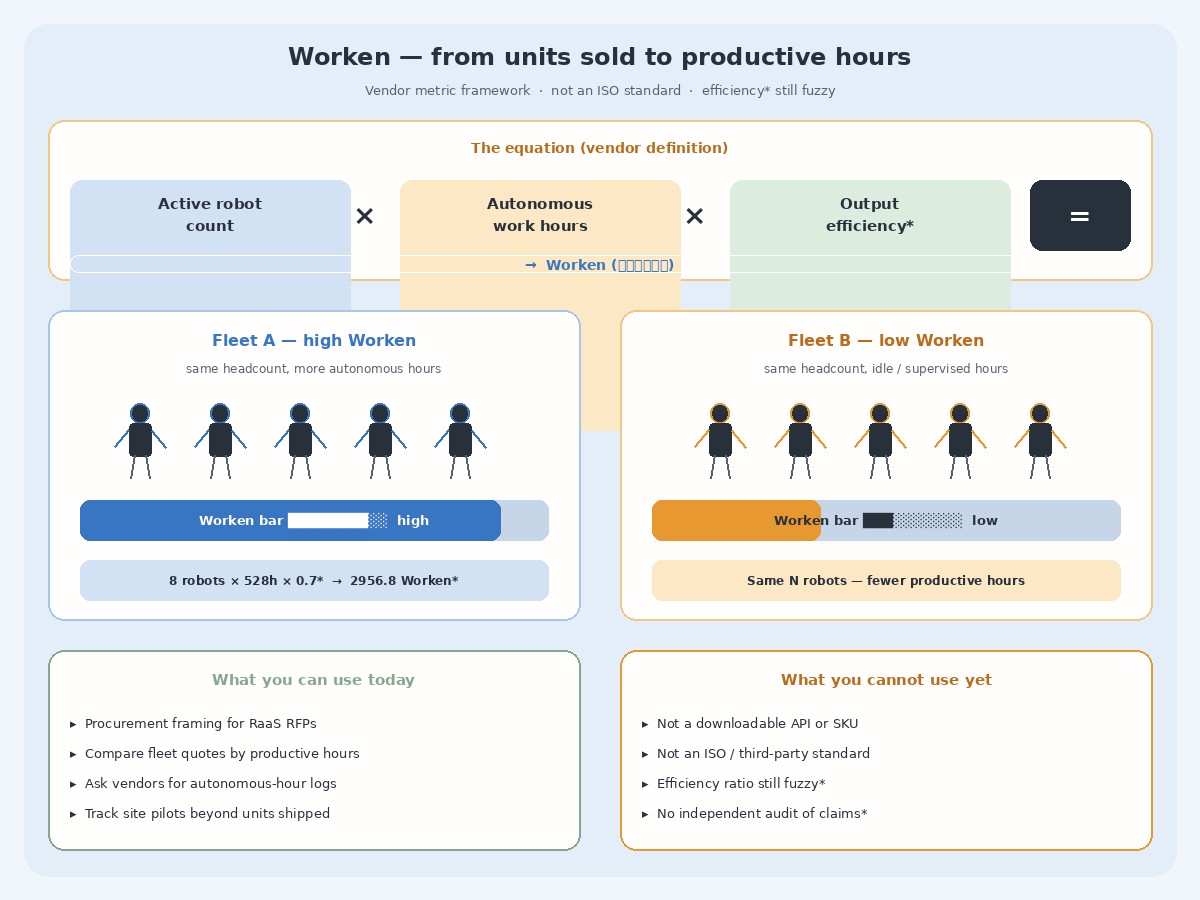
Same headcount, different Worken — the buyer question the metric is meant to force. Efficiency-ratio measurement remains fuzzy*; no independent audit yet.
Worked examples from Chinese coverage
Press write-ups around the event circulate arithmetic examples that make the three-factor shape concrete (treat the efficiency scalars as vendor/press illustrations*):
- Longqi (龙旗) factory loading/unloading — 8 robots × 528 h × 0.7 = 2956.8 Worken*
- Guangzhou Metro security guidance — 120 robots × 240 h × 0.5 = 14400 Worken*
Other application scenes cited in Chinese press include Chengdu Kuanzhai Alley visitor service, hotel and retail guide deployments, Chimelong entertainment, ASD retail floor guidance, and Shangri-La hotel front-desk cases. Separately, industrial coverage of Longqi’s Nanchang line has described multi-day G2 “并线” (co-line) runs with high reported task success — useful deployment context, but not the same thing as a audited Worken ledger.
Vendor scale claims at the event*
Alongside the metric, Peng disclosed AGIBOT operating numbers that Chinese financial press repeated (all vendor / Counterpoint-cited, not independently audited here):
- ~20,000 cumulative general AI robots offline (第20000台 in September 2026, per coverage)*
- H1 2026 shipments ~9,700 units*; H1 2026 revenue nearly ¥2B (接近20亿元)*
- ~43% global humanoid market share claim* (Counterpoint-cited ~43.1%* in some write-ups)
Those figures explain why AGIBOT wants a post-shipment metric: once cumulative volume crosses a scale threshold, “how many did we build?” stops answering “how much productive labor did customers actually get?”
What the industry report actually says
The same day, Xinhua’s China Economic Information Service and CAICT Shanghai’s industrial innovation center released 《2026具身智能产业创新报告》. Worken and related deployment cases appear inside it as a lead-enterprise exploration. CAICT Shanghai chief expert Zheng Zhongbin (郑忠斌) is quoted to the effect that such an indicator set moves valuation from hardware sales toward productivity delivery — and gives RaaS / hourly billing a shared measuring stick if the industry ever adopts it.
The report’s own caveat matters more for overseas readers than the marketing analogy: the indicator is still enterprise exploration; whether it becomes a common industry scale requires repeated validation across more scenes. In other words, AGIBOT proposed a ruler; the report did not certify it as the industry ruler.
What changes for a fleet / RaaS buyer
If you evaluate Chinese humanoid or general-purpose robot vendors for factory, metro, hotel, or retail pilots, Worken changes the questions you ask, not the contract you can sign tomorrow:
- Ask for active vs installed counts — warehouse inventory is not fleet labor.
- Ask for autonomous-hour logs with a clear definition of human takeover.
- Ask how the vendor measures the efficiency ratio — and expect fuzziness. AGIBOT executives have themselves described that third factor as still relatively vague* (hotel robots that cover two of ten human-role tasks are the kind of example Chinese interviews use).
- Treat Worken-linked billing as a future RaaS shape, not a current rate card. Coverage notes that today’s commercial mix is still mostly hardware sales plus some day/event rental; Worken-based metering is aspirational.
Keep this distinct from this morning’s ChinaHotTech piece on AGIBOT GO-3 Preview + Lingqu OS — that article covers the deploy-time learning stack and open-source plans. Worken is the commercial measurement layer, not another hardware SKU.
Caveats
- Vendor metric, not ISO — no third-party standard or independent audit of Worken ledgers yet.
- Efficiency ratio is fuzzy* — AGIBOT itself has acknowledged measurement ambiguity across factory vs hotel vs metro tasks.
- ~43% share* / ~¥2B H1 revenue* / 20k cumulative* — event and press disclosures; Counterpoint-cited share in some reports; not re-audited here.
- Worked examples* — Longqi 2956.8 and Guangzhou Metro 14400 Worken figures circulate in Chinese coverage as illustrations; treat efficiency scalars as vendor/press numbers.
- Not a product SKU — you cannot download Worken, call an API endpoint for it, or buy a “Worken meter” board. Use it as RFP language and internal KPI design.
- Report framing — Xinhua CEIS + CAICT Shanghai record Worken as enterprise exploration inside the 2026 embodied-AI industry innovation report, not as a ratified national or international standard.
Bottom line: Worken is AGIBOT’s bid to make robot labor countable the way tokens made model inference countable. For overseas RaaS and fleet buyers, the useful takeaway is the three-factor question set — active count, autonomous hours, efficiency definition — not a claim that the industry has already agreed on a standard. Keep the asterisks on the share, revenue, and example arithmetic until a third party can audit them.