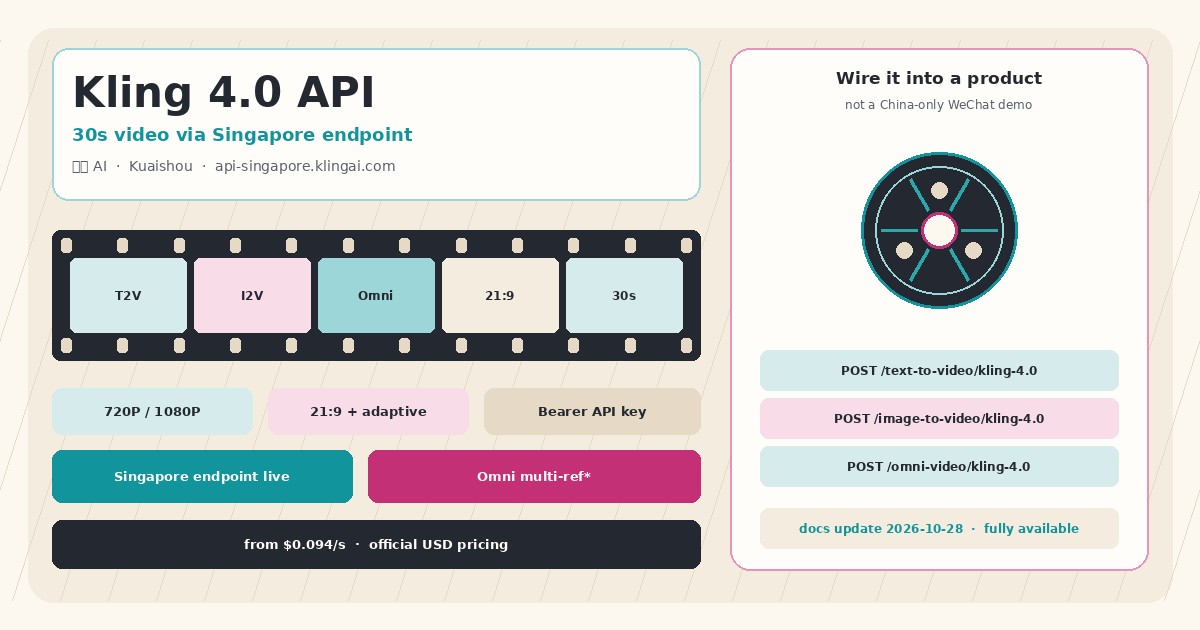
Chinese video models have spent years living behind WeChat mini-programs, invite codes, and credit UIs that overseas product teams cannot meter. Kling 4.0 is the opposite posture: a Singapore API domain, public developer console, Bearer authentication, and a pricing page denominated in dollars per second. That is the practical change — not another demo reel, but a contract surface you can put behind a queue worker.
Who ships it
Kling AI (可灵 AI) is Kuaishou’s (快手) generative video product line. The consumer and creative surface sits at klingai.com; the developer surface is kling.ai/dev. Chinese coverage around Oct 21–22 (新浪 / official Weibo open-apply notes; 财联社 / 东方财富 on first API launch) preceded the docs update that marks full availability on 2026-10-28. Product-page messaging around a 4.0 full launch earlier in mid-October (~Oct 15) is consumer-facing; treat the API timeline as docs-driven, not press-driven.
Yes. Create an account with email at kling.ai/dev, buy resource packs or top up, mint a Bearer API key at kling.ai/dev/api-key, and call https://api-singapore.klingai.com. This is a global Singapore endpoint — not a China-region-only WeChat flow. You still need a funded account and you must follow the published duration billing rules; there are no open weights to download.
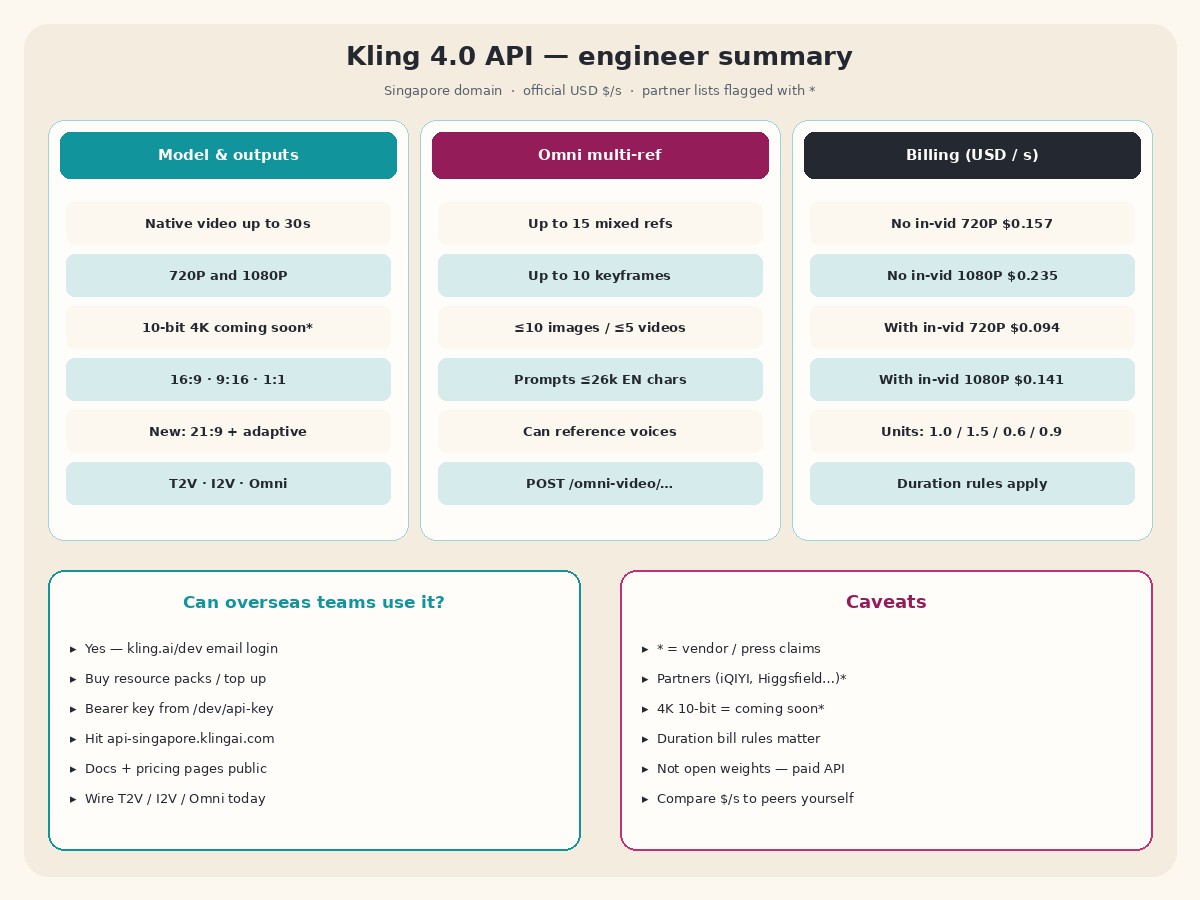
Three columns from the public docs — outputs, Omni multi-ref, USD $/s billing — plus the “can you call it” checklist and asterisked caveats.
What the model exposes
On the documented surface, Kling 4.0 generates native video in a single run up to 30 seconds. Resolutions today are 720P and 1080P; vendor materials mention 10-bit 4K coming soon* — leave that as a roadmap claim until the pricing and endpoint pages list it. Aspect ratios include the usual 16:9, 9:16, and 1:1, with newly supported 21:9 and adaptive framing.
Three POST routes sit under the Singapore domain:
POST /text-to-video/kling-4.0POST /image-to-video/kling-4.0POST /omni-video/kling-4.0
Auth is a standard Bearer API key. Changelog and capability notes live under kling.ai/document-api/updates/api.md; base video pricing is at kling.ai/document-api/pricing/base/video.md.
Omni multi-reference
The Omni route is the multi-modal control surface. Documented limits: up to 15 mixed reference inputs; up to 10 keyframes; up to 10 reference images and 5 reference videos; English prompts up to roughly 26,000 characters. Omni can also reference voices directly — useful if you are stitching character consistency across clips rather than hoping a single text prompt holds identity. Treat those ceilings as API contract numbers from the docs, not as quality guarantees.
Pricing (official USD)
The published Kling 4.0 schedule (official pricing page) is per second of billed duration:
- No input video — 720P $0.157/s (1.0 unit); 1080P $0.235/s (1.5 units)
- With input video — 720P $0.094/s (0.6 units); 1080P $0.141/s (0.9 units)
Duration rules matter for cost models: if input duration ≤ output duration, you are billed output × 2; if input > output, you are billed input + output. That is a different shape from flat “credits per clip” UIs — build your estimator against those two branches, not against a single sticker price. Mental comparison to Runway / Luma / Pika-class APIs is fair for product planning; stick to published Kling numbers here rather than inventing peer quotes.
Partner surface (press*)
Chinese and partner-facing coverage has named consumer and creative tools integrating or showcasing Kling 4.0, including 爱奇艺纳逗Pro, Higgsfield, LibTV, Magnific (Freepik), 美图, OpenArt, OiiOii, TapNow, 腾讯设计 Miora, and updream. Flag the whole list as press* — useful as a distribution signal, not as a verified partner directory or SLA map.
What changes
If you already meter video APIs for product features (storyboard tools, ads pipelines, social clip factories), Kling 4.0 gives you a Chinese frontier-class generator with a Singapore endpoint, three clear routes, Omni multi-ref, and dollar-denominated $/s you can put in a spreadsheet today. The 30-second native length and 21:9 support are the product-facing deltas versus shorter-clip eras; Omni’s image + video + voice refs are the control-facing delta.
It does not give you open weights, a free tier with production SLAs, or a promise that 4K 10-bit is live. Keep it distinct from other ChinaHotTech coverage this week: AGIBOT GO-3 + Lingqu OS is robotics / embodied OS (morning today), XHEART X7 Ultra is an automotive chip, Apex-35B is an open LLM, and RLinf is embodied RL infra — none of those are video APIs.
Caveats
- Paid API, not open weights — you buy resource packs / top up; there is no Hugging Face dump.
- 4K 10-bit = coming soon* — roadmap language until docs and pricing list it.
- Duration billing branches — input≤output bills output×2; input>output bills input+output. Mis-model this and unit economics break.
- Partner names are press* — iQIYI 纳逗Pro, Higgsfield, LibTV, Magnific/Freepik, Meitu, OpenArt, OiiOii, TapNow, Tencent Design Miora, updream, etc.
- Timeline nuance — open-for-apply ~Oct 21; full API availability marked by docs update 2026-10-28; consumer 4.0 launch messaging ~Oct 15 is separate.
- Quality claims — stick to documented length, resolution, aspect, Omni limits, and $/s; do not import vendor demo adjectives as facts.
Bottom line: Kling 4.0’s Singapore API is a concrete integration target for overseas product teams — 30-second native video, Omni multi-ref, Bearer auth, and published USD per-second rates — as long as you keep the asterisks on roadmap and partner claims and price against the real duration rules.