Most world-action models inherit “world” knowledge from video generators or vision-language models, so 3D structure stays implicit or arrives as an optional side channel. E0.5 flips that design: start from a backbone that already thinks in depth, points, and cameras, then train it end-to-end to reconstruct the scene that is about to happen while an action expert reads those geometry features layer by layer. For overseas robotics engineers comparing π0-style WAMs, 4D world models, and Chinese open drops, the concrete question is whether predicting future geometry actually moves success rates — and whether you can clone enough of the stack to try it.
What E0.5 actually does
At train time the model sees three camera streams (head + left/right wrist), a language instruction, and proprioception. The VGGT-Omega 3D backbone is not frozen: it must predict future depth, point maps, and camera parameters at a fixed offset into the action chunk, while a flow-matching action expert emits the next joint-action chunk (paper / project page: 32-step × 14-D for the RoboTwin dual-arm setup*). At deployment only the action path runs — the future-geometry head is a supervision signal, not an inference tax.
That distinction matters for anyone who has watched “geometry-aware” policies collapse into bolted-on depth nets or reconstruction losses that never change the control loop. E0.5’s claim is architectural: geometry is the backbone’s native language, and future geometry is what teaches the features the action expert consumes.
As paper + project page reading — yes: arXiv 2610.36011 and x-era.com/e05. As code and weights — also yes, with caveats: GitHub X-EraAI/e05 is public (MIT-licensed code path; README now includes Conda/CUDA install, scripts, and docs — treat it as an early research drop, not a one-click hobbyist kit). Hugging Face hosts a RoboTwin policy checkpoint (X-EraAI/e05-robotwin, intermediate step_109000.pt*), an embodied-pretrained VGGT branch, and a large processed RoboTwin dataset (~378 GiB*). Custom PyTorch loader — not Transformers AutoModel. As a robot you can buy — no. Not a Digi-Key SKU, not a fleet RaaS meter, and real-robot numbers below are lab benches*.
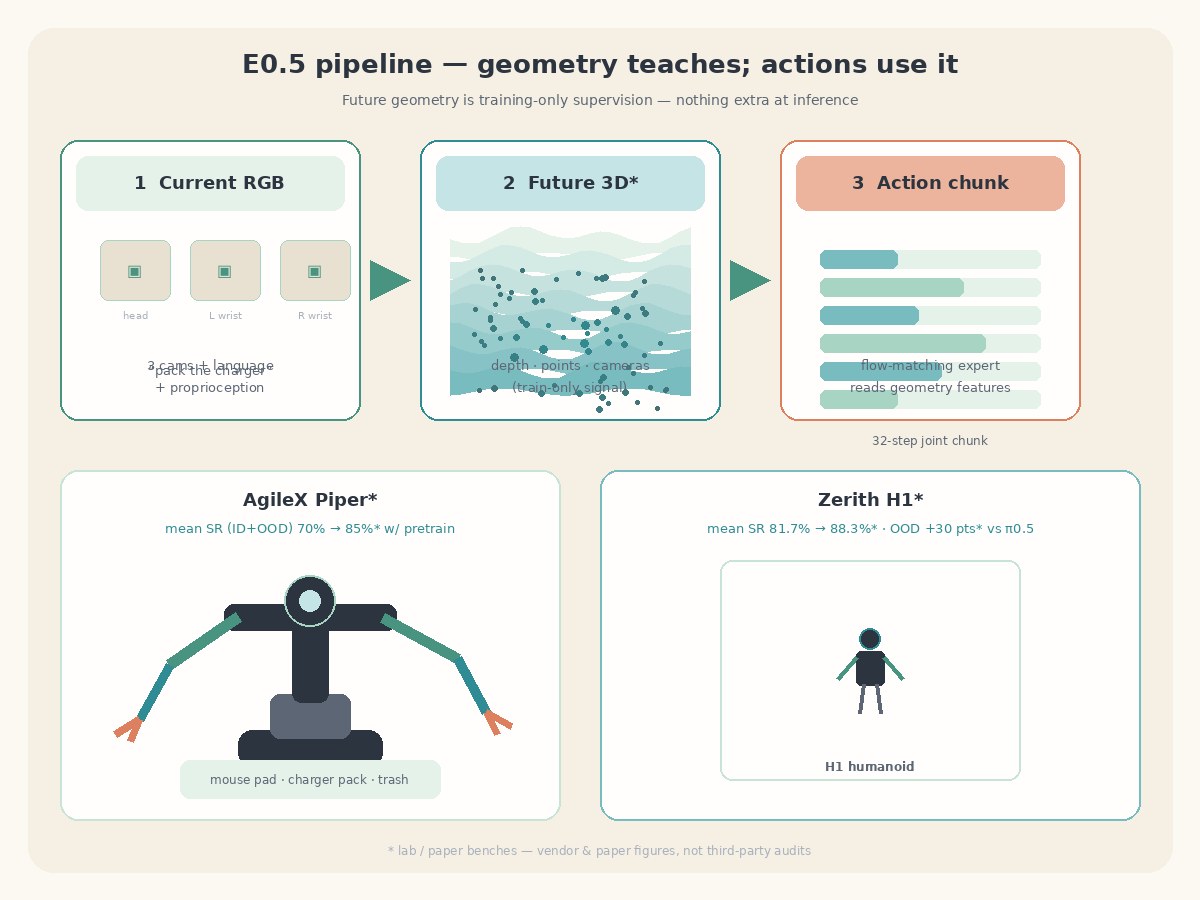
Current RGB → future 3D (train-only) → action chunk. Piper and H1 insets summarize paper real-robot means*; asterisks mark lab/paper figures.
Simulation: RoboTwin 2.0 without embodied pretrain
On RoboTwin 2.0 with a 2.32B policy core, 50 clean demos per task, and no embodied pretraining, the paper reports:
- Clean success 89.90%*
- Randomized success 50.09%* (domain randomization the policy never saw in training)
- ~70%* average across clean + randomized
Ablations on the same budget: supervising with future geometry adds about +9.4 pts* average success versus no reconstruction, and about +7.9 pts* versus reconstructing only the current scene. That is the headline scientific claim for overseas readers — predicting where the world is going beats reconstructing where it already is, under matched compute and data.
Embodied pretrain and real robots vs π0.5*
After pretraining on >160k AgiBotWorld-Beta trajectories (~2,650 h*), the paper reports real-robot gains on two embodiments with head + dual wrist cameras:
- AgileX Piper — mean SR (ID + OOD) 70.0% → 85.0%* with pretrain
- Zerith H1 humanoid — mean SR (ID + OOD) 81.7% → 88.3%* with pretrain; H1 OOD mean with pretrain 76.7%* vs π0.5 46.7%* (+30 pts*)
Tasks cited: mouse-pad placement, charger + cable packing, trash disposal — each with ID and OOD variants (unseen poses / objects). Comparisons mix “no pretrain” (Gemma-initialized π0.5 vs E0.5) and “pretrained” (official π0.5-base vs AgiBotWorld-pretrained E0.5); treat the whole table as paper/lab protocol*, not a third-party audit. Ten trials per cell is the disclosed protocol on the project page*.
Not the same stack as ViGAR
ChinaHotTech covered ViGAR on Oct 27 — a visual-subgoal world-action approach on a different stack (A2). E0.5 is a separate line: geometry-native future-3D WAM on VGGT-Omega, with explicit future depth/points/cameras as train-time targets. Same broad “world-action” buzzword family; different backbone bet and different open artifacts. Do not merge the two when skimming Chinese embodied-AI headlines.
What changes for an overseas lab
If you already run OpenPI / π0.5, RoboTwin, or AgiBotWorld-style pipelines, E0.5 changes three concrete checks:
- Backbone choice — ask whether your WAM’s “world” module is video/VLM-native or 3D-foundation-native, and whether future geometry is a real loss or a slide.
- Ablation hygiene — the +9.4 / +7.9 pt* future-vs-none / future-vs-current gaps are the figure to replicate or refute under your own seed and camera set.
- Reproduce path — clone GitHub, pull the HF RoboTwin checkpoint (custom loader), expect Linux + CUDA (upstream install notes target multi-GPU training; single-GPU inference is the lighter path). The published 109k RoboTwin weight is an intermediate epoch-50-of-70 checkpoint*; real-robot fine-tunes use a separate embodied VGGT resource.
Caveats
- Lab / paper benches* — RoboTwin %, Piper/H1 means, OOD deltas vs π0.5, and hour counts come from the E0.5 report and project page; not independently re-run here.
- Early open drop — repo and HF cards are public and documented, but this is research software: Conda/CUDA, Vulkan for sim eval, large data (~378 GiB processed RoboTwin*), custom checkpoint format.
- Intermediate sim checkpoint* — HF
e05-robotwinstep_109000 is not framed as the final 70-epoch model; HF card also notes historical eval denominators that are not a full 10k-episode re-benchmark. - Not a product SKU — no commercial robot, no hosted control API, no Digi-Key board. Use it as a paper + open weights experiment.
- Licensing — code path is MIT per repo notices; weights and data carry separate third-party / dataset terms — read HF cards and
THIRD_PARTY_NOTICES.md. - Distinct from ViGAR — different geometry-native vs visual-subgoal design; do not treat Oct 27 and Oct 31 ChinaHotTech pieces as the same model.
Bottom line: E0.5 is X-Era AI’s bet that future geometric structure — not just current reconstruction or video priors — is the right inductive bias for world-action policies. Overseas labs can read the paper today, clone the public repo, and load the HF RoboTwin checkpoint with the project’s own loader. Keep the asterisks on every success rate until you reproduce them on your robots.