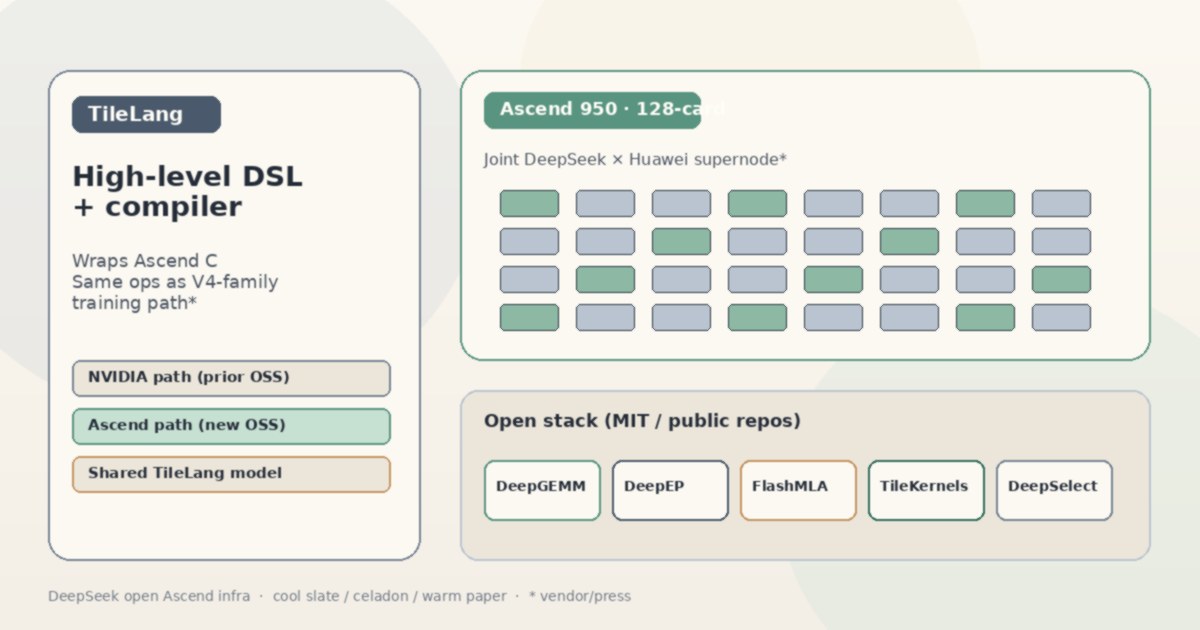
China’s AI labs have spent years proving they can train strong models when they can get enough GPUs. The harder question — especially under export pressure — has been whether Chinese NPUs can host a software stack that developers will actually write for: languages, compilers, GEMM libraries, collective communication, attention kernels. DeepSeek’s Ascend open-source drop is aimed at that layer. It does not ship a consumer card you can order from Digi-Key; it ships the kind of low-level pieces that decide whether a card that “can run” starts to “run well.”
What shipped
Per DeepSeek’s WeChat announcement (English summary via Geopolitechs, 2026-09-30) and Chinese follow-up coverage (凤凰网风物研报, 2026-11-01), the open set covers:
- TileLang — high-level language + compiler toolchain; Ascend path wraps Ascend C and exposes a high-level interface. DeepSeek says TileLang implements the majority of operators used to train the DeepSeek V4 family, and that every TileLang operator currently used in DeepSeek training now has a corresponding high-performance Ascend implementation*. Primary repo: tile-ai/tilelang (Ascend-specialized work also appears under tilelang-ascend).
- DeepGEMM-Ascend — matrix-multiply kernel library for Ascend NPUs; MIT-licensed; API-compatible with DeepGEMM; BF16 / FP8 / FP4 GEMM, MQA logits, MegaMoE; developed/validated on Ascend 950; requires CANN 9.20* toolkit +
torch_npu(README). Dense BF16 case reported ~99.8%* hardware utilization on Ascend 950DT under a specified CANN env (ifeng). Repo: deepseek-ai/DeepGEMM-Ascend. - DeepEP-Ascend — high-performance communication for training/inference on Ascend: MoE expert-parallel all-to-all (dispatch/combine, FP8 dispatch), plus experimental PP / CP / DP Bucket collectives and Engram remote memory APIs; public buffer APIs aligned with NVIDIA DeepEP. Repo: deepseek-ai/DeepEP-Ascend.
- TileKernels — common vector compute and memory-access operators for data processing. deepseek-ai/TileKernels.
- FlashMLA — sparse attention operators for long-context efficiency. deepseek-ai/FlashMLA.
- DeepSelect — efficient data selection. deepseek-ai/DeepSelect.
DeepSeek’s own wording: each of these has a direct counterpart among the components previously open-sourced for NVIDIA platforms, and across key test cases compute and communication performance is “already approaching the limits of the underlying hardware”*. Huawei’s Ascend community post (2026-09-30) additionally cites DeepEP interconnect figures on a UBL128 supernode — Dispatch ~375 GB/s* / Combine ~347 GB/s* — as near hardware ceiling*. Treat those as vendor/community measurements.
As readable, cloneable open source — yes: the GitHub repos are public (DeepGEMM-Ascend is MIT). As something you can run on a laptop or a Western cloud GPU — generally no. Requirements are Ascend 950-class NPUs plus CANN (DeepGEMM-Ascend README: CANN 9.20*, torch_npu, Python ≥3.10). Western readers without Ascend access still get an architecture and ecosystem signal: what DeepSeek thinks it needs to train V4-family workloads on Chinese silicon, and how close the kernels claim to sit to the metal. Teams already on Ascend or evaluating China cloud / NPU stacks can treat the repos as a shorter path from “card can run” to “card runs well.”
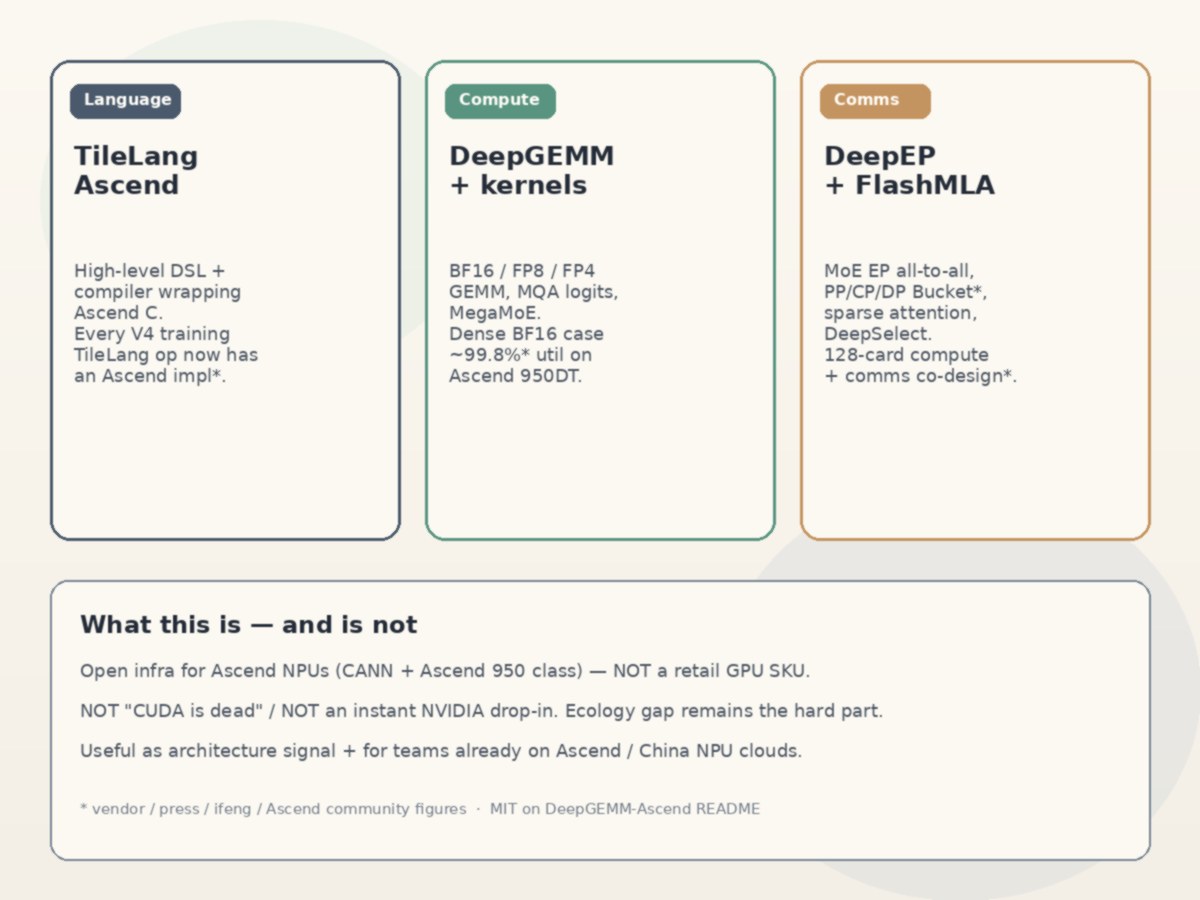
Language / compute / comms split + access caveats — the three overseas checks. Asterisks mark vendor / press / Ascend community figures.
128-card Ascend 950 supernode
DeepSeek states that Huawei’s team was deeply involved, and that the two sides jointly worked on a 128-card supernode based on Ascend 950 with deep optimization of both computation and inter-chip communication*. Ascend community materials describe SuperPoD Flex / UBL128 networking (128-card scale-up*) supporting that joint work. By ~2026-11-01, Chinese coverage (ifeng) notes that code in the public projects can be viewed, tested, and iterated — the announcement is no longer vapor.
What changes vs CUDA inertia
- Another runnable software stack option for teams that can access Ascend — not a marketing slide claiming CUDA is obsolete.
- Abstraction bet — TileLang is pitched as a simpler programming model than CUDA that still aims at hardware limits, validated first on NVIDIA, then ported so the same development approach can sit above either GPU or Ascend*. If that holds, porting cost falls; if not, you still have open reference kernels.
- Kernel + comms gap shrinks — open GEMM, EP collectives, sparse attention, and data-selection pieces shorten the path from bringing up a card to extracting utilization (ifeng’s BF16 ~99.8%* figure is the headline signal for that claim).
- Ecology remains the hard part — compilers, debuggers, profiling, hiring, and decades of CUDA muscle memory do not vanish because six repos went public. Competition can still matter before “full replacement”: new projects that already fit Ascend + these tools create a second option at procurement time.
Caveats
- Not a retail GPU SKU — Ascend 950 + CANN class infrastructure; geo and supply access matter for Western hobbyists and many cloud buyers.
- Not “CUDA is dead” — DeepSeek and Huawei are co-building an alternative stack; they are not claiming instant drop-in replacement of NVIDIA software or hardware.
- Utilization / bandwidth figures* — BF16 ~99.8%* (ifeng / specified CANN env); DeepEP Dispatch/Combine GB/s* (Ascend community) are vendor/press measurements under named conditions.
- V4 operator claim* — “every TileLang operator used in DeepSeek training has an Ascend impl” is DeepSeek’s statement.
- Software ecology gap — open kernels help; they do not equal a complete CUDA-class toolchain overnight.
Bottom line: DeepSeek open-sourced the Ascend counterparts to its NVIDIA-side infra — TileLang, DeepGEMM, DeepEP, TileKernels, FlashMLA, DeepSelect — and co-optimized a 128-card Ascend 950 supernode with Huawei*. For overseas engineers, read it as an architecture and ecosystem signal plus usable code if you already have Ascend access — not as a Digi-Key board, and not as the funeral of CUDA.