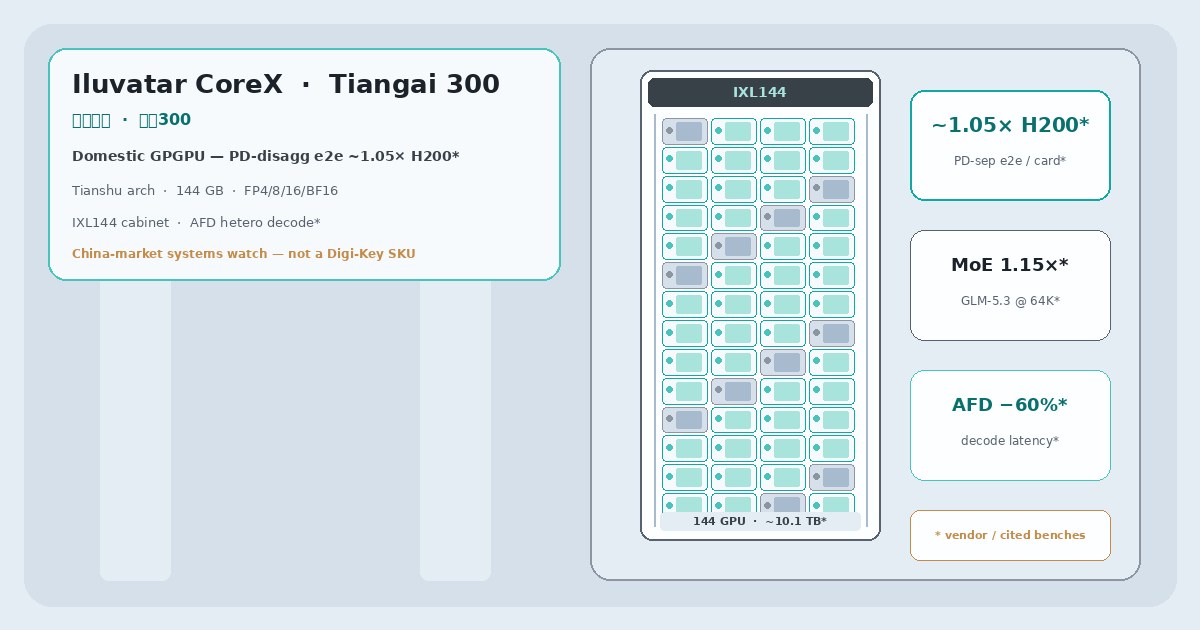
For overseas readers the useful questions are narrower than “did China match H200?” Peak FLOPS tables already mislead. What Iluvatar is selling into domestic buyers is usable tokens under a specific deployment — PD separation, long-context Attention/MoE, Agent first-token latency — plus a cabinet density story (IXL144) and a hetero decode story (AFD with partner XPUs). SCMP summarized the company line as matching / beating H200 on live multimodal demos; Chinese trade press (21经济网, 雷峰网, 快科技) carried the Shanghai Yidian 1.05×* figure and the lab deltas. Treat every number as conditioned on unpublished full methodology until someone else re-runs it.
What shipped (and what was shown)
Per company framing and Chinese coverage of the media open day:
- Tiangai 300 (天垓300) — general-purpose GPU on Tianshu (天枢); 144 GB memory; native scalar / vector / tensor paths; precisions called out include FP4, FP8, FP16, BF16; high-speed chip-to-chip interconnect. Formally launched around WAIC 2026 (July); media open-day demos ~2026-10-28 Shanghai.
- System ladder — accelerator card → 8-GPU server → IXL144 supernode: 144 GPUs in one standard cabinet, aggregated memory about ~10.1 TB*. Iluvatar calls this the densest single-cabinet GPU supernode in the industry* — marketing language, not an audited ranking.
- AFD (Attention–FFN Disaggregation) — beyond PD split: Prefill + Decode-Attention stay on Tiangai 300; Decode FFN / expert compute can run on partner XPU silicon, with activations shuttled between devices. Cited demo: Decode latency down about 60%* vs the compared setup.
- Edge: 彤央 TY1200 — edge compute terminal quoted at 300 TOPS dense INT8* (not sparse peak). Company / press benches vs NVIDIA Thor T5000 on Qwen-class LLMs about ~1.2×*; Cosmos-R2-2B / 8B figures around 158% / 180%* of Thor in the same briefings. Next SKU previewed: TY2000 ~600 TOPS dense*.
As a China domestic system / partner deployment — that is the path Iluvatar describes (cards, 8-GPU boxes, IXL144 cabinets, software stack with Agent/Skills tooling, plus TY1200 edge modules). As something an overseas engineer can buy on Digi-Key, AWS, Azure, or GCP tomorrow — no. There is no public Western-cloud SKU, no hobbyist board listing, and export / procurement realities for China GPGPUs still dominate. Watch this for competitive pressure, software-stack maturity, and how Chinese buyers mix GPU + XPU — not as a drop-in H200 replacement in your US/EU cluster.
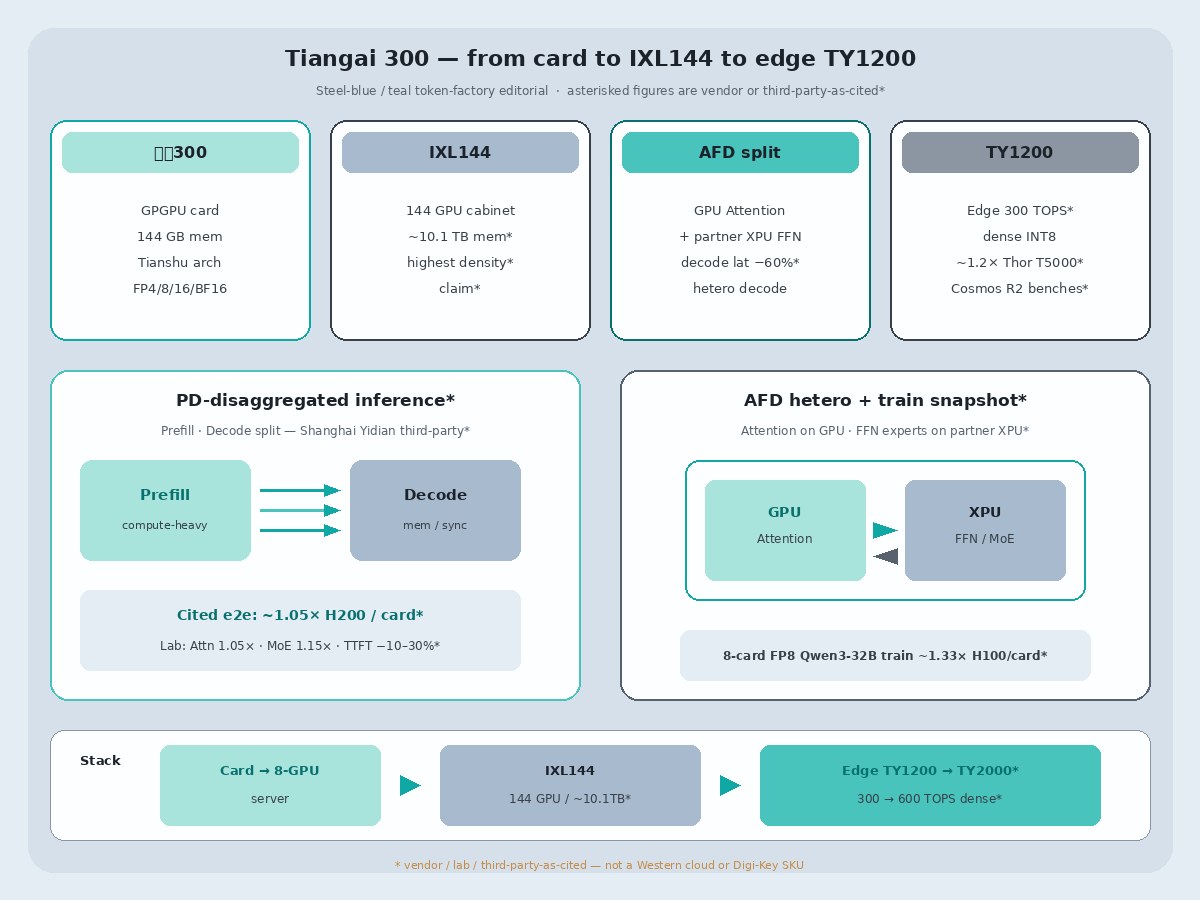
Card → IXL144 → AFD hetero → TY1200 edge. Asterisks mark vendor / lab / third-party-as-cited benches.
Benches* (third-party-as-cited + lab)
Prefer primary Chinese reporting over secondary blogs. Key cited figures:
- Shanghai Yidian third-party (PD-disagg)* — normalized per-card end-to-end throughput ≈ 1.05× H200* under a “typical” Prefill/Decode separated deployment. Media (快科技 / 21经济网 / 雷峰网) frame this as the first domestic general GPU to reach H200-class measured e2e in that setup*. Full model list, batch/concurrency, software stack, and H200 config were not published in the articles we re-fetched — non-reproducible from press alone.
- Iluvatar performance lab* — Attention ≈ 1.05× H200 @ 64K*; MoE throughput ≈ 1.15× H200* on GLM-5.3 @ 64K under equal UX constraints*; Agent first-token latency about 10–30% lower* vs H200 across 8K–128K*; multimodal generation throughput about +2–5%*; search/ads/rec online: recommendation inference throughput +21%*, lightweight compute latency −26%*.
- Training demo* — 8-card FP8 training on Qwen3-32B: effective per-card throughput ≈ 1.33× H100 / card* (media open-day / 快科技).
- Cost framing* — some Chinese coverage cites ~40% lower cost per million effective tokens* vs “international mainstream” for the IXL144 path — vendor economics, not an independent TCO study.
- SCMP — English confirmation that Iluvatar claims H200 parity / multimodal outperformance at the media demo; H200 noted as the most advanced Nvidia AI GPU currently exportable to China under US rules. Does not independently re-benchmark.
What changes for an overseas stack
- Inference competition is shifting to e2e under PD / AFD layouts — not just peak TFLOPS. If you track China accelerator supply, ask vendors for the same PD-disagg and MoE long-context recipes, not only GEMM tables.
- Heterogeneous decode is becoming a product story — GPU keeps Attention generality; partner XPUs take FFN/experts. That is a systems-software bet as much as a chip bet.
- Cabinet density + software Agents — IXL144’s 144-GPU / ~10.1 TB* pitch and the Agent/Skills software-stack demos (migration “hours,” PD deploy cut from ~1h to ~20 min in the staged demo*) matter for Chinese buyers who already own mixed fleets.
- Edge continuity — TY1200’s “dense 300 TOPS*” framing vs Thor is aimed at robots / on-prem agents that want cloud-trained stacks offline. Still a China product line first.
- Distinct from recent ChinaHotTech chip posts — not Biren 壁砺300; not XHEART’s automotive LLM SoC; not DF1000’s 3D near-memory without HBM. Tiangai 300 is a classic GPGPU + cabinet + hetero-inference narrative.
Caveats
- Third-party-as-cited* — Shanghai Yidian’s 1.05×* figure is reported via Iluvatar / Chinese media; we did not obtain the full Yidian report. Method gaps (models, concurrency, software, H200 SKU/firmware) block independent reproduction.
- Lab numbers* — Attention / MoE / TTFT / multimodal / rec deltas are Iluvatar performance-lab results as carried by press.
- AFD −60%* — applies to the demonstrated hetero Decode setup vs the compared baseline in that demo, not a universal “GPU alone is 60% slower” claim.
- Train 1.33× H100/card* — open-day 8-card FP8 Qwen3-32B demo; not a full training-cluster audit.
- TY1200 vs Thor* — company/press model benches; Thor T5000 naming and configs as reported in Chinese coverage.
- Not a Digi-Key / Western cloud SKU — China systems and partners; overseas teams cannot treat this as an H200 substitute they can buy into next week’s fleet.
- Naming hygiene — Tiangai 300 ≠ Biren 壁砺300; ≠ XHEART; ≠ DF1000.
Bottom line: Tiangai 300 is Iluvatar CoreX’s bid that a domestic GPGPU can compete with H200-class end-to-end inference under PD-disagg*, then extend that story into dense cabinets, GPU+XPU decode, and dense-TOPS edge boxes. Overseas readers should track the methodology gaps and the China-only procurement reality — useful competitive intelligence, not a cart-checkout SKU.