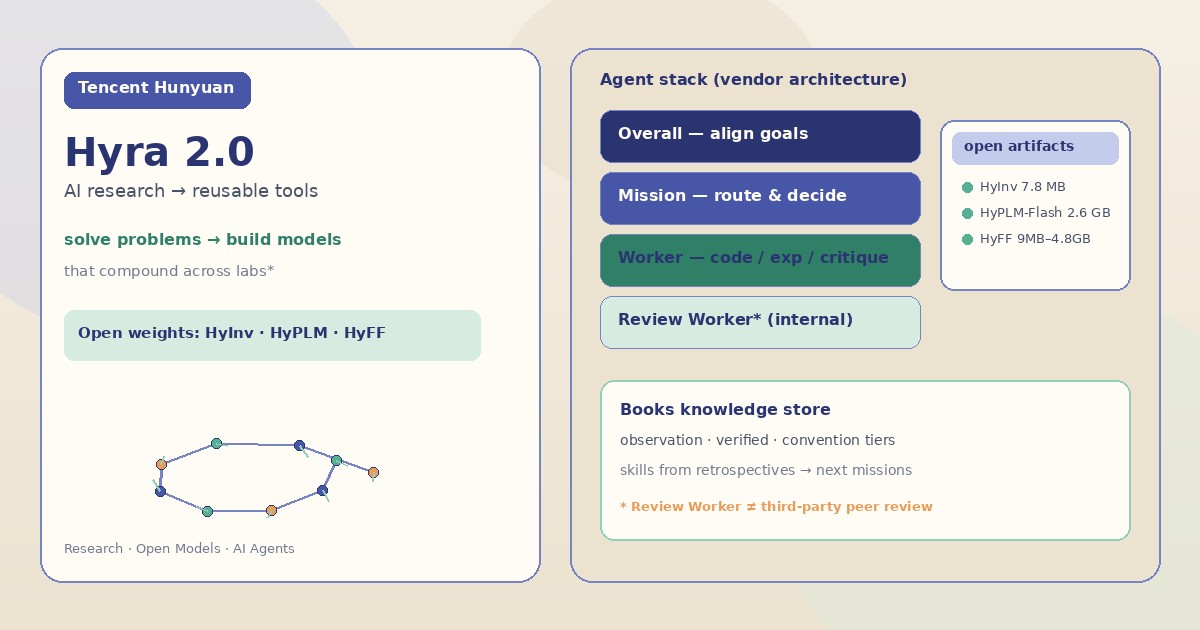
Most “AI solves science” demos end when the leaderboard screenshot ages out. Hyra 1.0 already showed a tight loop — propose, experiment, score — good enough to help crack a long-open additive-combinatorics question*. Hyra 2.0’s claim is different: once you ship a protein model or a force field, every later drug-design or MD job can call it again. Compounding tools beat one-off answers. That is the reason to care if you actually download weights.
How the agent is wired
Per Hunyuan’s research page, Hyra 2.0 splits work into three agent layers. Overall talks to human researchers and keeps goals aligned. Mission owns a single research question over a long horizon and chooses routes. Worker agents read code, run experiments, diagnose failures, and can push back on Mission judgments. A separate Review Worker sits in the loop — important caveat: that is an internal checker, not third-party peer review.
State is split across project status, layered agent memory, and a shared knowledge store called Books, with observation / verified / convention tiers. Retrospectives can be packaged as skills that later missions call directly. Press coverage (IT之家, 同花顺) frames the shift as moving from “刷题解题” (grind problems) to “造工具” (build tools). Treat the compounding story as Tencent’s thesis until outside labs reproduce the skill-transfer effect on their own stacks.
The science-model artifacts — not the full Hyra agent. Weights and inference code for HyInv, HyPLM-Flash, and the five HyFF force fields are on GitHub Releases (Apache-2.0–style packaging; some READMEs also cite MIT for individual model packages — check the repo LICENSE before you ship). There is no public Hyra API, SLA, or WeCom harness for outsiders. This is not Digi-Key hardware and not a chat product.
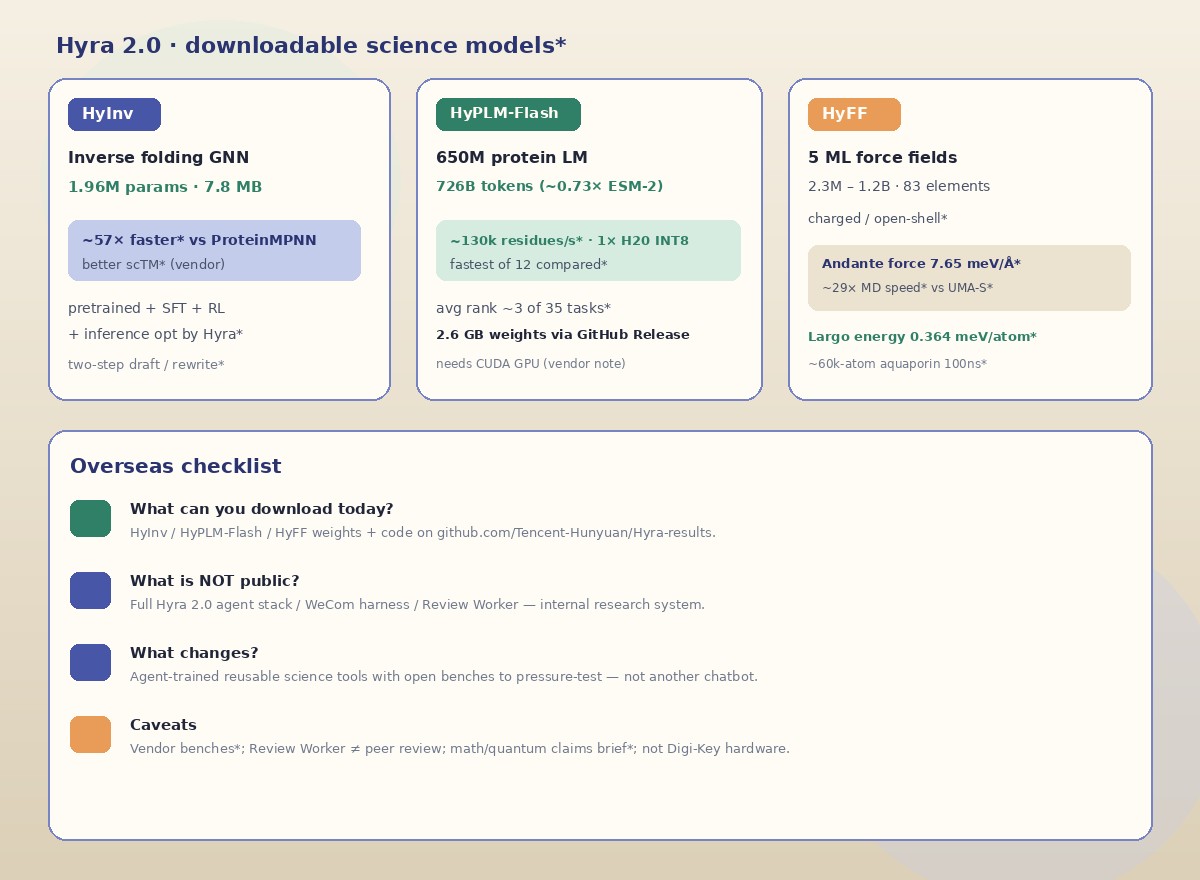
HyInv / HyPLM-Flash / HyFF cards + overseas checklist. Asterisks mark vendor or press figures — not independent China Hot Tech benches.
HyInv — tiny inverse folding, open weights
HyInv is a 1.96M-parameter graph neural net for protein inverse folding: given a backbone, propose sequences that should fold into that shape. Hunyuan says Hyra handled pretraining, SFT, RL, and inference optimization end-to-end, including a two-step draft/rewrite sampler*. Versus ProteinMPNN, they claim better structural consistency (scTM*) and roughly 57× faster* generation. The weight file is about 7.8 MB — small enough to pull on a laptop before you argue about the benches. Message-passing design echoes ProteinMPNN (four-layer encoder / three-layer decoder per README notes); CPU and GPU both work*.
HyPLM-Flash — 650M protein LM with an INT8 story
HyPLM-Flash is a 650M (6.5亿) masked protein language model trained on 726B tokens — about 0.73× the data used for ESM-2 650M, and a fraction of newer 600M-class encoders*. Vendor comparison: fastest inference among 12 PLMs tested*, average rank about 3 of 35 tasks*. The headline throughput claim is an INT8 engine at roughly 130k residues/s on one H20*. FP32 weights are ~2.6 GB via a two-shard GitHub Release. Unlike HyInv, CUDA is expected. If you already run ESM-class encoders for mutational effect or annotation, this is the artifact to time against your own harness — do not take the 35-task average as gospel without the report tables.
HyFF — five ML force fields for MD
HyFF ships five atomistic force-field models from 2.3M to 1.2B parameters (presto → largo), covering 83 elements with charged and open-shell support*. Each atom routes through its element-specific subnet. Against 16 public models, Hunyuan places all five on an accuracy–speed Pareto front*. Snapshot numbers they highlight: Andante force error 7.65 meV/Å* versus UMA-S-1.2 at 7.55* with about 29× MD speed*; Largo energy error 0.364 meV/atom* — lowest among the evaluated set*. Weight sizes span roughly 9 MB to 4.8 GB. The package includes NVE/NVT/NPT MD tooling; demo claims include a ~60k-atom aquaporin membrane for 100 ns* and a ~46k-atom enzyme reaction trajectory*. Those are vendor case studies — replicate before you trust reaction pathways.
Brief side claims (keep them brief)
The same release wave mentions a quantum LDPC construction HyQEC [488,123,22]* with kd²/n 122*, a Petty conjecture result in dimension 5*, Xiangshan RISC-V SPEC CPU2006/GHz geo-mean +5.79%*, and fuzzing finds on OpenLLC*. Interesting if formal write-ups hold; they are not the downloadable protein/MD story, so we flag them and move on.
Caveats
- Review Worker ≠ peer review — internal agent role; do not read it as Nature refereeing.
- Vendor benches* — ProteinMPNN speedups, PLM ranks, HyFF MAE / ns·day figures come from Hunyuan / press; method cards are still rolling out.
- Weights ≠ full Hyra — you get science models and reports; not the Overall/Mission/Worker runtime, WeCom hooks, or Books store.
- License hygiene — check each package LICENSE (MIT called out in some secondary coverage; release packaging reads Apache-2.0–style).
- Not Digi-Key / not a Western cloud SKU — software artifacts you can clone; no hardware to order.
Bottom line: Hyra 2.0 is Tencent arguing that research agents should ship tools that compound. Overseas researchers can already pull HyInv, HyPLM-Flash, and HyFF and pressure-test the claims on their own GPUs. Treat the agent-system narrative and every asterisked number as vendor thesis until independent benches land — and keep the distinction clear between downloadable science models and the closed Hyra control plane.