
Most “AI 3D” demos still stop at a pretty mesh. BitInfinite’s CIIF pitch is the opposite: treat natural language or a sketch as a brief, emit parametric modeling code, verify and iterate, then hand you a design file with parameters, features, assembly relationships, and modeling history* — something that can enter print, simulation, or manufacture without a human rebuilding topology from scratch*. That is the gap the company’s Sparkoh.ai Web page on the CIIF online hall spells out for overseas 3D-print makers*.
Who BitInfinite / Sparkoh.ai is
Legal name: 上海比特无限人工智能科技有限公司; product brand Sparkoh.ai; English press often uses BitInfinite / BitInf Ltd. Press and prior coverage put 李士麒 as CEO* and 周平义 Pingyi Zhou (ex Huawei 盘古 core*) as chief scientist*; the company is listed in NVIDIA Inception*. Zhou’s name also appears on the ECCV 2026 first-place certificate with the Wuhan University / BitInf Spatial Design Intelligence Lab author list — useful as an authorship signal, not as an independent bio audit.
Product surface for makers: sparkoh.ai web (“Idea to CAD”)* — NL or sketch in, parametric code + CAD-kernel execution out*. Partner path: API into 3D-print vendors, industrial software, and robot / world-model companies that want interactive dynamic 3D sim assets for embodied AI*. That is the CIIF exhibit copy; treat API SLAs and pricing as unspecified unless you talk to them.
Yes — try the Sparkoh.ai web path as a maker* (the CIIF hall frames it for global overseas 3D-print users*). There is also an API / partner path* for vendors and robotics/sim teams. This is not a local open-weight model you download tonight, and it is not Digi-Key silicon. Expect cloud UX, possible Vercel/auth gates, and vendor rate limits — verify export quality on your own STEP/STL tooling before you trust a print job.
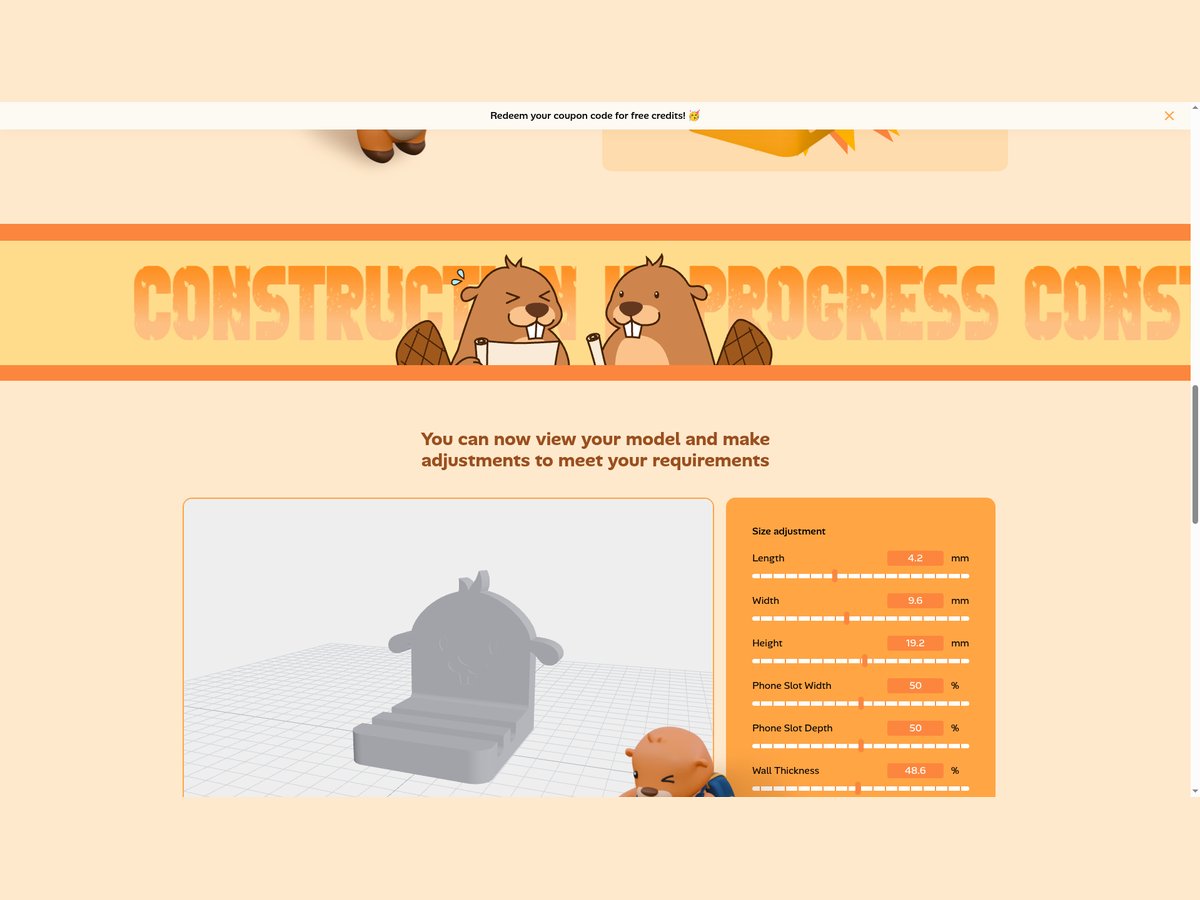
Real product screenshot from sparkoh.ai: generated phone-stand 3D with parametric size sliders (length/width/height, phone-slot, wall thickness) — manufacturable CAD path in the browser, not mesh wallpaper or AI art.
Arko series: what changes vs mesh generators
Vendor framing of the Arko family*: text→CAD, image→CAD, pointcloud/mesh→CAD, plus a natural-language CAD editor*. The stack sits on a parametric modeling language + OpenCascade (OCC) kernel* and claims to emit editable, manufacturable industrial STEP/STL* — “not display meshes” is their own contrast*. Arko-T is the text path: NL → a Build123d Physical-3D program → CAD entity after kernel execution*.
On their internal Text2CAD-Bench vs GPT / Claude / Gemini / DeepSeek / Qwen / Kimi / GLM*, Arko-T claims 8 first / 3 second of 12 metrics*, ~0.41 s per sample*, ~$0.28 for the full bench*, and >10× faster than LLM-API baselines*. Asterisk every one of those — vendor bench, not a third-party lab report, and “faster / cheaper than calling a general LLM API” is a different claim from “beats SolidWorks on a production drawing revision.”
CIIF floor: NL → printer, not just a slide
上观新闻’s 徐汇 roundup places Sparkoh inside the first-time 模速空间 cluster at the CIIF AI experience zone — eight incubator companies spanning chips, 3D generation, hardware, and agents*. The BitInfinite line there is blunt: physical-3D foundation models that compute manufacturable, assemblable, movable engineering models with math and code*, Arko covering text / image / pointcloud CAD plus an editor*, and a floor demo where visitors walk natural language through a desktop 3D printer*. The floor story matches the product UI above: makers iterate params in the browser, then a desktop printer can close the loop at the 模速空间 cluster demo*.
ECCV 2026: a manufacturing-shaped leaderboard
Separate from the maker web pitch, BitInfinite + Wuhan University took first place in the ECCV 2026 workshop challenge The Path to Manufacturing: Evolving 3D Generation to Intelligent Computer-Aided Design — specifically Render + TechDraw → STEP BRep, score 96.39*, ahead of 27 other teams (Wuhan.gov English + the certificate above). Public train 8,344 / test 927*. Evaluation uses OCC to mesh predictions and score Surface / Edge / Vertex / Topology F1 plus a valid-sample ratio* — missing files, kernels that fail to open, meshing failures, or timeouts count invalid*. Organizers also capped submissions and required beating a baseline before ranking*, which filters “looks good in a viewer” entries. That is a useful academic signal for “emit a solid a kernel can open,” still short of shop-floor tolerance proof or closed-loop drawing revisions a mechanical engineer would sign.
What changes (and what does not)
- Maker web exists* — Sparkoh.ai aimed at overseas 3D-print users; try it, then re-check STEP/STL in your CAM stack.
- STEP/STL + params/features/assembly/history* — the product claim vs mesh-wallpaper generators; verify on real parts.
- OCC / Build123d path* — geometry kernel story is concrete; quality still depends on the generated program.
- Text2CAD-Bench numbers* — vendor; asterisk latency, cost, and 8/12 firsts.
- ECCV 96.39 first place* — workshop challenge on Render+TechDraw→STEP; not a factory acceptance test.
- Not an open local weights dump — web + API partner path*; no Digi-Key board.
- Distinct from this morning’s Visinex VS815V chip post — software CAD / physical-3D, not edge-vision silicon.
Bottom line: if you care about China AIGC that targets manufacturable CAD instead of glamour meshes, Sparkoh.ai / BitInfinite’s Arko stack is a concrete watch item — a maker-facing web surface*, an OCC-backed STEP story*, a live 3D-printer demo at 模速空间*, and an ECCV manufacturing-workshop win with Wuhan U*. Keep the asterisks on CEO/scientist bios, NVIDIA Inception*, and every bench row until you have exported parts that survive your own inspection.