
On October 31, 2026, the 2026 Intelligent Sensor (Wuxi) Innovation and Development Conference — themed “AI toward the real, sensing toward intelligence” (AI向实 传感赋智) — put twelve Wuxi High-tech Zone sensor companies on a World Internet of Things Exposition–branded stage. MEMSIC was one of them, listed alongside Huajing Sensing (华景传感), Beiwei Sensing (北微传感), and Lingzhang Robotics (灵掌机器人). Two days later, on November 2, it published an official Chinese news note on three chips spanning inertial sensing, angle sensing, and intelligent drive — “sense, measure, actuate,” in the vendor’s wording.
The three parts are a 6-axis IMU that earlier MEMSIC and 集微网 / Jiwei copy names MIC6200AL, the MDA2000BT AMR magnetic encoder, and an eOIS driver the November 2 note calls MSD4200WA*. That is a full-stack pitch: attitude, joint angle, and camera stabilization in one announcement. Several headline numbers disagree across MEMSIC’s own pages, and one package outline in the launch note contradicts the product page. Those conflicts are the point of reading the note next to the listings, not past them.
What the launch note actually specifies
The IMU integrates a 3-axis gyroscope, a 3-axis accelerometer, and a dedicated ASIC, with what the company calls a distinctive A+G dual-cavity pressure-control design*. MEMSIC says the chip took five years to develop* and that “key performance sits in the same dimension as world TOP-3 products”*. The November 2 figures are a gyroscope sensitivity error of 1%*, zero-bias as low as 3 dps*, and a temperature sensitivity coefficient of 0.02%/°C*, plus a first-line customer’s 60,000-cycle drop test and 20 kg-class shock testing with zero failures*. The customer is not named, and no public MIC6200AL product page or datasheet PDF turned up on memsic.com — the 6-axis family page still leads with an older part, MIC6102AL.
The encoder is aimed at robot-joint angle. MEMSIC leans on AMR (anisotropic magnetoresistance) work and what it calls the advantage of owning an AMR wafer fab* to argue that magnetic encoders can take share from optical encoders where dust, oil, shock, or a tight envelope make a glass disk awkward. The launch note quotes a linear error of ≤0.07°*, 21-bit resolution*, 120,000 RPM*, a 3 × 3 mm QFN*, on-chip ASIC self-calibration*, SPI/PWM/UVW/ABZ*, three-temperature calibration capacity of 12 million pieces a year*, and an estimate that this is enough to take on about 40% of the optical-encoder substitution market*. That QFN line does not match the product page: both the Chinese listing (mag-encoder-88) and the English listing (cbm-87) specify a TSSOP-16 measuring 5.1 × 4.5 × 1 mm. We treat the product-page outline as official and the launch-note QFN claim as unverified and conflicting.
The third chip, MSD4200WA* in the November 2 note, is an eOIS driver. The note claims 40 dB suppression*, fast-settling PID control*, 1 μm precision*, output resistance down to 1.8 Ω*, standby current of 150 μA*, an I3C interface for high-end platforms*, and a grade of CIPA 5 or above*, including for concert shooting in low light*. Those figures have no public MSD4200WA datasheet behind them. The eOIS catalog page we retrieved still describes a different SKU, MSD4100WA.
Packaged chips — but not ones we could find on Digi-Key or Mouser. Searches on November 9, 2026 for MIC6200AL, MDA2000BT, MSD4200WA, and MSD4100WA did not return matching Digi-Key catalog pages. Older MEMSIC accelerometers and magnetometers do appear in that index; these launch names did not. We also could not independently confirm a live Mouser listing (the manufacturer index returned an access error, and SKU searches did not surface matching pages). Do not plan a reel around a distributor SKU that has not been published. The sales path printed on the launch note and product pages is direct: [email protected], with phones in Shanghai (+86 021-62330696), Wuxi (+86 0510-66616668), Shenzhen (+86 0755-23306109), and Tianjin (+86 022-59896226). English pages live at memsic.com. The company publishes no pricing, sample calendar, minimum order, or qualification grade for these three parts, and we are not inventing any.
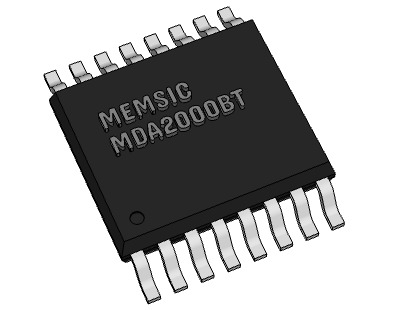
Official package rendering of the MDA2000BT AMR magnetic encoder from MEMSIC’s product page, marked MEMSIC / MDA2000BT in a TSSOP-16 outline. This is vendor product art, not a laboratory photograph. The same page lists the package as TSSOP-16, 5.1 × 4.5 × 1 mm — which conflicts with the November 2 news note’s “3 × 3 mm QFN” claim.
The 6-axis IMU — and why two MEMSIC texts do not say the same thing
Jiwei’s pickup, and MEMSIC’s own May 20, 2026 English note “Precision Sensing Solutions: Full-Stack Empowerment for the Nerve Endings of Embodied Intelligence,” give the IMU a part number, MIC6200AL, and a slightly different sheet: gyro bias as low as ±3 dps*, thermal drift held to ±0.05 dps/°C*, and sensitivity error of ±1%*. The November 2 launch note never prints MIC6200AL in the text we retrieved, but it is the only 6-axis IMU MEMSIC has been publicly attaching these robot-oriented numbers to. Treat that identification as earlier copy, not as a marking we photographed on a package.
The more important mismatch is not the plus-minus signs. It is the temperature line. “Temperature sensitivity coefficient 0.02%/°C”* (November 2) is a scale-factor tempco: how much the gyro’s sensitivity changes with temperature, in percent per degree. “Thermal drift ±0.05 dps/°C”* (May 20 / Jiwei) is a bias tempco: how much the zero-rate output walks, in degrees per second per degree. Those are different physical quantities, and MEMSIC has not published both on one official IMU product table. Until a MIC6200AL datasheet appears, quote each figure with its source rather than collapsing them into a single “temp drift” bullet.
A+G dual-cavity pressure control* is the vendor’s phrase for the mechanical arrangement; there is no public cross-section, cavity pressure, or process node. The 60,000-drop and 20 kg-class shock claims* name no customer, no test standard, and no plot. “Same dimension as world TOP-3”* names no competitor. The 6-axis family page still highlights MIC6102AL — LGA 2.5 × 3 × 0.83 mm, a large FIFO, I²C/I3C/SPI, and output data rates up to 2,200 Hz. Those are MIC6102AL figures, not MIC6200AL figures, and we are not borrowing the older package for the new name.
The MDA2000BT encoder, from the product page
Prefer the product page when it conflicts with the press note. On memsic.com/cn/mag-encoder-88 and the English page memsic.com/cbm-87, MDA2000BT is specified as measurement range 0–360°; INL (typical after self-calibration) < ±0.07°; turn / loop counting up to 65,536; supply 3.3–5.0 V; operating temperature −40 to 125 °C; system propagation delay at constant speed 2–8 μs; maximum speed < 120,000 rpm on the Chinese page and 120,000 rpm on the English page (the less-than sign is missing in English); ABZ 1–16,384 lines programmable; UVW 1–16 pole pairs programmable; PWM 12-bit; SPI absolute angle 21-bit over 4-wire SPI; interfaces SPI / PWM / ABZ / UVW; and package TSSOP-16, 5.1 × 4.5 × 1 mm.
Several of those cells correct the November 2 note. The press note’s “linear error ≤0.07°”* is close to the product-page INL but drops the ±, the “typical after self-cal” qualifier, and the < versus ≤ distinction. The May 20 English note and Jiwei quote INL as low as ±0.06°* — tighter than the current product page. We are not averaging those numbers: the live page is < ±0.07° typical after self-calibration; ±0.06° is earlier marketing copy.
The package conflict is sharper. “3 × 3 mm QFN”* appears in the launch note as the reason the chip “can be embedded in a robot dexterous hand and other tight spaces.” The product-page rendering, marked MEMSIC / MDA2000BT, is a 16-pin TSSOP at 5.1 × 4.5 × 1 mm. That is still a small IC, and a magnetic encoder does not need an optical disk’s line of sight — the real packaging argument versus a glass-disk encoder. It is not a 3 × 3 mm QFN on the product page. Until MEMSIC updates one of the two documents, treat the QFN line as a conflicting, unverified claim.
The 21-bit SPI absolute-angle figure and the SPI/PWM/UVW/ABZ interfaces are consistent across the product page, the launch note, and the May/Jiwei copy. Maximum speed is “up to 120,000 RPM” in the launch note, “< 120,000 rpm” in Chinese, and “120,000 rpm” in English — same order of magnitude, not quite the same printing. The 12-million-unit three-temperature calibration capacity* and the “about 40% of the optical-encoder substitution market”* estimate appear only in the launch note; “substitution market” is not the entire optical-encoder market.
On May 20, MEMSIC’s English note quoted CTO Jiang Leyue (蒋乐跃) on the MDA2000BT’s 21-bit SPI interface and INL “as low as ±0.06°”* for high-degree-of-freedom humanoid joints. A November 4 follow-up interview, attributed to “global CTO Stephen,” repeats the three-line argument without new numbers: inertial sensors for body attitude, a high-performance encoder for fine motion, and visual-stabilization products for camera scenes. We are not assuming Stephen and Jiang Leyue are the same person; the two bylines are printed as they appear.
The eOIS driver: MSD4200WA* on the launch note, MSD4100WA in the catalog
Image stabilization is the “actuate” end of the sense–measure–actuate slogan — and the line MEMSIC describes as stepping out of its sensor comfort zone into driver ICs. The November 2 note names the launched part MSD4200WA* and quotes 40 dB*, 1 μm*, 1.8 Ω*, 150 μA standby*, I3C*, and CIPA 5+*. The May 20 English note and Jiwei add a sibling, MSD2100WA, said to support a 1 MHz I²C clock and an embedded voice-coil-motor control algorithm*, while MSD4200WA* is said to integrate a linear Hall sensor and a PID control algorithm*.
What the public catalog actually shows today is MSD4100WA, on memsic.com/image-stabilization-85: a one-chip voice-coil-motor eOIS driver with a linear Hall-effect sensor, an H-bridge, and a PID algorithm*. That page lists a 2.65–3.6 V analog supply*, 1.2–3.6 V I/O*, I²C up to high-speed mode (3.4 MHz)* plus I3C up to 12.5 MHz*, a 16-bit Hall ADC*, a single-channel 11-bit constant-current linear driver rated Imax = 170 mA*, and a 6-pin WL-CSP typically 0.63 × 2.37 × 0.315 mm*. Those figures belong to MSD4100WA. The November 2 note does not publish a package outline or Imax for MSD4200WA, and we are not copying the 4100’s WL-CSP dimensions onto the 4200 name. Treat “MSD4200WA” as the launch name* and read the 4100 page as the currently documented eOIS catalog part, not as a drop-in datasheet for the October 31 chip.
Who the vendor is
MEMSIC Semiconductor Co., Ltd. (美新半导体) dates its founding to 1999. The company about page describes it as one of China’s earliest IDM-mode inertial-sensor suppliers, with research and production in China, Europe, and the United States and sales across Asia-Pacific, Europe, the Americas, and Africa. Products it says it already ships at scale include its thermal accelerometers (a historically distinctive MEMSIC technology), capacitive accelerometers, AMR geomagnetic sensors, low-power Hall switches, and 6-axis IMUs. Marketing counters on that page read 27 years of MEMS experience, more than 4.5 billion chips shipped, 50+ global agencies, and 300+ end customers* — company figures, not audited disclosures we checked.
The same page records a December 14, 2007 NASDAQ listing, described there as the first MEMS company listed on that exchange; the establishment of MEMSIC Semiconductor (Tianjin) Co., Ltd. in September 2019, with Tianjin listed as headquarters; capacitive accelerometer and gyroscope work from early 2020; an A-round of more than one billion RMB in January 2021; and a 2025 national-level “Little Giant” (专精特新“小巨人”) designation. Chief executive officer, per the about page, is Lu Jian (卢牮). Wuxi is listed as the R&D, operations, and manufacturing center (2 Xinhui Loop Road, Xinwu District), with additional offices in Shanghai, Shenzhen, Shaoxing (manufacturing), and Hong Kong (logistics). For an overseas robotics or handset team, the design-in path is a conversation with those offices — not a cart on Digi-Key, at least not today.
What changes (and what does not)
- Three packaged chips, one Wuxi stage — a 6-axis IMU, MDA2000BT, and an eOIS driver named MSD4200WA*, pitched as sense–measure–actuate for phones, wearables, and robots.
- IMU numbers are launch-copy, not a datasheet — 1% / 3 dps / 0.02%/°C* on November 2; MIC6200AL with ±3 dps* and ±0.05 dps/°C bias drift* in May 20 / Jiwei copy. Those temperature figures are different metrics. Do not borrow MIC6102AL’s LGA package.
- Drop and shock claims are vendor* — 60,000 drops and 20 kg-class shock, zero failures*, unnamed customer, no published test standard.
- MDA2000BT official package is TSSOP-16, 5.1 × 4.5 × 1 mm — the November 2 “3 × 3 mm QFN”* line conflicts and is treated here as unverified.
- MDA2000BT official INL is < ±0.07° typical after self-calibration — not the earlier ±0.06°* figure. 21-bit SPI absolute angle, SPI/PWM/ABZ/UVW, 3.3–5.0 V, −40 to 125 °C, turn count to 65,536, max speed < 120,000 rpm (CN) or 120,000 rpm (EN).
- 12 million pcs/year three-temperature calibration* and “~40% of the optical-encoder substitution market”* are launch-note estimates only.
- eOIS MSD4200WA* is the launch name — 40 dB*, 1 μm*, 1.8 Ω*, 150 μA*, I3C*, CIPA 5+*. The live catalog part is MSD4100WA (6-pin WL-CSP 0.63 × 2.37 × 0.315 mm typ.*). Do not transfer that package to the 4200 name.
- Not found on Digi-Key or Mouser under these SKUs as of November 9, 2026. Inquire via [email protected] or the Shanghai / Wuxi / Shenzhen / Tianjin numbers. No public pricing or sample calendar.
Bottom line: if you are sizing a humanoid joint, a robot IMU, or a camera OIS loop and you have been looking at magnetic encoders as a way off optical disks, MEMSIC just put real part numbers and a conference-stage photograph behind that pitch. Read the MDA2000BT product page rather than the press-note QFN line, keep every IMU and eOIS performance claim asterisked until a datasheet arrives, and do not expect to click “add to cart” on Digi-Key tonight.