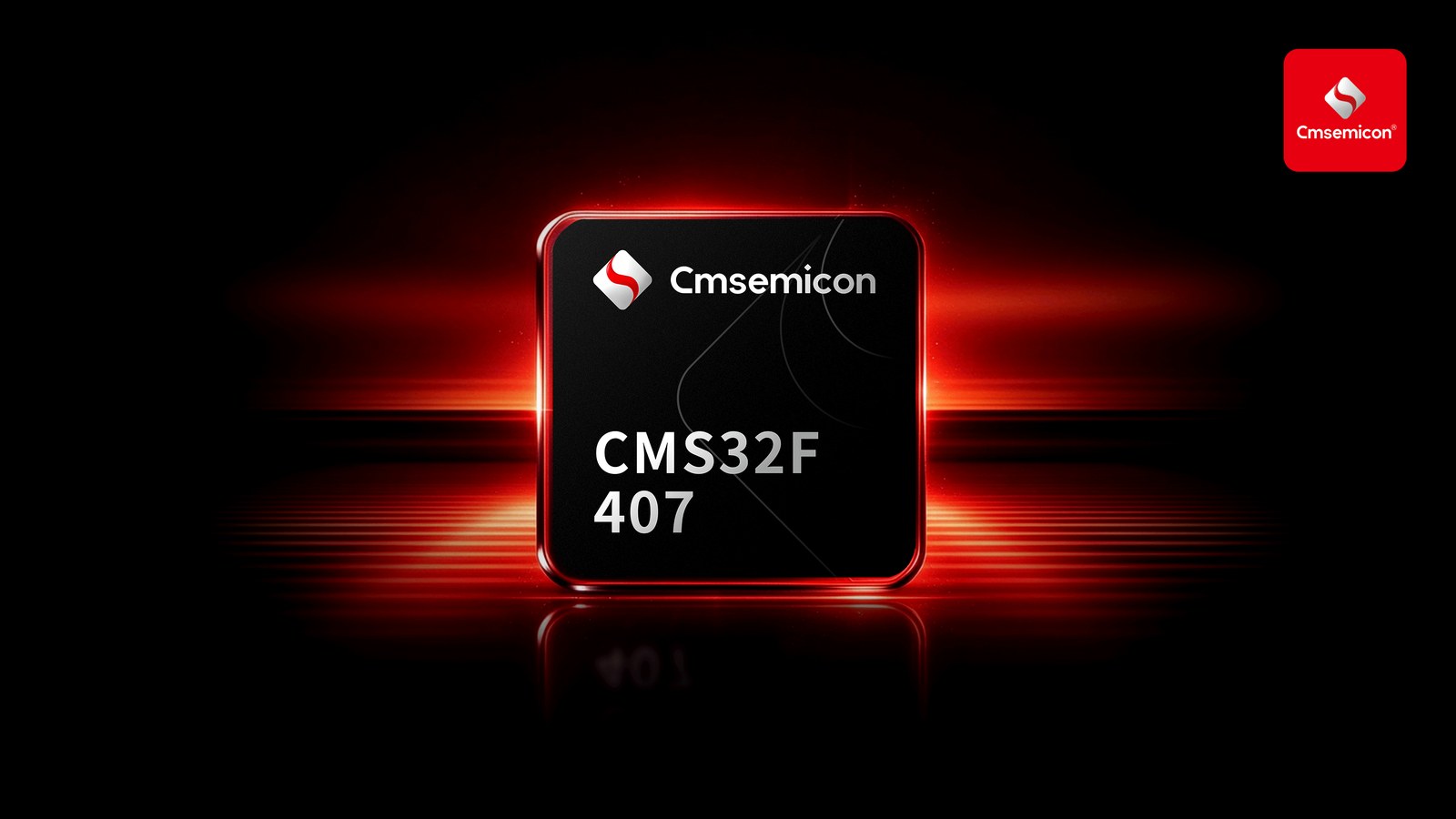
On November 2, 2026, Cmsemicon — 中微半导体(深圳)股份有限公司, listed in Shanghai as 688380.SH — published a Chinese product note launching the CMS32F407 series. The headline numbers are why a firmware engineer outside China will pause: an Arm Cortex-M4F running up to 168 MHz*, 512 KB or 1 MB of Flash*, 192 KB of SRAM*, two 8-channel DMA controllers*, up to 82 GPIO*, Ethernet*, two USB ports*, two CAN controllers*, a DCMI camera interface*, SDIO*, and a parallel LCD controller in 8080/6800 modes*. Those are the same headline specifications that STMicroelectronics made familiar with the STM32F407 class — and Cmsemicon’s four SKU suffixes line up with ST’s familiar pin-and-density letters as well.
That rhyme is the hook, and it is also the line we will not cross. The November 2 note does not claim pin compatibility, register compatibility, library compatibility, or a drop-in replacement for any ST device. Neither do we. This is an evaluation note about a named Chinese MCU whose catalog line deliberately parallels a part many Western teams already design around, not a substitution guide. Samples, a StarKit evaluation board, an SDK, and documentation are already being offered to customers*, with volume production planned for 2027 Q1*. ST’s STM32F407 remains widely stocked on Digi-Key. This Cmsemicon line, as of our check, is a China-direct sample request.
What the November 2 note actually lists
The core is an Arm Cortex-M4F at up to 168 MHz*. Flash comes in two densities, 512 KB and 1024 KB*, paired with 192 KB of SRAM* on every SKU in the selector. Cmsemicon says that combination is sized for complex control algorithms, graphical UI, multi-layer protocol stacks, and large data buffers* — vendor wording, not a benchmark we ran. Two groups of 8-channel DMA* are listed to move peripheral traffic without sitting on the CPU.
Analog and I/O are where you should keep the two official sources next to each other. The news note lists three 12-bit ADC units and two 12-bit DACs, with an internal voltage reference, and “up to 16 external channels”* in total. A spec graphic on the same news page restates that as a 16-channel 2 Msps high-speed ADC* plus two high-precision DACs*. The English product-selector table lists the same three 12-bit ADC units and two 12-bit DACs, but quotes 24 ADC channels at 2 Msps*. The 2 Msps figure is consistent across the graphic and the table; the 16-versus-24 channel count is not. If you request a sample, ask which number is the external-pin count and which includes internal sources — that is a normal datasheet clarification, not a gotcha invented here.
Connectivity in the news note is written out as 4× USART plus 2× UART (the selector collapses that to UART = 6), 3× SPI with two channels able to mux as I2S, 3× I2C, 2× CAN, 2× USB, 1× Ethernet, 1× DCMI, 1× SDIO, and a parallel LCD interface in 8080/6800 modes*. GPIO is “up to 82”* in the news copy, which matches the selector: 82 pins on the LQFP100 SKUs and 51 on the LQFP64 SKUs*.
The timer set is two 16-bit advanced timers, ten 16-bit general-purpose timers, and two 16-bit basic timers — fourteen timers, which is also the number the selector prints — with up to 36 independent PWM outputs*. An RTC, a true-random-number generator, and a hardware CRC unit* are listed alongside. The operating window is industrial: −40 to +105 °C* and 2.0 to 3.6 V VDD*.
Four SKUs sit on the official table:
- CMS32F407RET6 — 512 KB Flash, LQFP64
- CMS32F407VET6 — 512 KB Flash, LQFP100
- CMS32F407RGT6 — 1024 KB Flash, LQFP64
- CMS32F407VGT6 — 1024 KB Flash, LQFP100
Those suffixes are not a coincidence we are pretending not to notice: in ST’s long-running F4 naming, R/V mark 64- and 100-pin outlines and E/G mark 512 KB and 1 MB of Flash, with T6 as the LQFP industrial-temp ending. Cmsemicon reused that lettering on parts that also reuse the 168 MHz M4F / 512-or-1024 / 192 SRAM headline. That is a naming and spec parallel. It is not evidence the pins, the memory map, or the ST HAL will line up.
Against the vendor’s own CMS32F103, the note says CMS32F407 sits as a higher-resource complement — more compute, more memory, more DMA, more GPIO, a display interface, richer analog, and broader communications* — aimed at helping customers land industrial-control terminals, intelligent-display devices, and IoT gateways* faster. That is product-family positioning, not a side-by-side datasheet we tabulated here.
The intended sockets in the launch copy are a familiar mid-range industrial and energy list: industrial control, FOC motor drive and motion control, industrial robots and automation; IoT and communications (PLC communication gateways, wireless protocol-conversion gateways, high-precision GPS terminals); smart home and consumer (drone flight control, smart-home controllers, digital mixers and higher-end audio); and digital energy (PV inverters, digital power supplies, high-power UPS)*. Treat that as the intended socket map, then verify timers, analog, and comms against your own board.
Ask Cmsemicon sales — this series is not one we could find on Digi-Key. Searches on November 10, 2026 for CMS32F407 and the four SKU strings above did not return a Digi-Key catalog product page. Digi-Key HTML was Cloudflare-challenged from our fetch path; no matching product URL surfaced via search either. By contrast, ST’s STM32F407 class remains widely listed there, which is exactly why the rhyme matters: the part you already buy is one cart click away, and this one is not. The November 2 note says samples, development kits, complete technical documentation, an SDK, and localized technical support are already being offered to customers*, with batch production and delivery planned for 2027 Q1*. The official eval board shown on the news page is branded CMS32F407 StarKit. No public Western-distributor stock, price, or minimum order was published, and we are not inventing any. The path printed around the note is Cmsemicon’s site, mcu.com.cn (English product page at mcu.com.cn/en/Products/426), the inquiry line +86 (755) 8671 5143, and [email protected], or the company’s regional sales offices and authorized distributors.
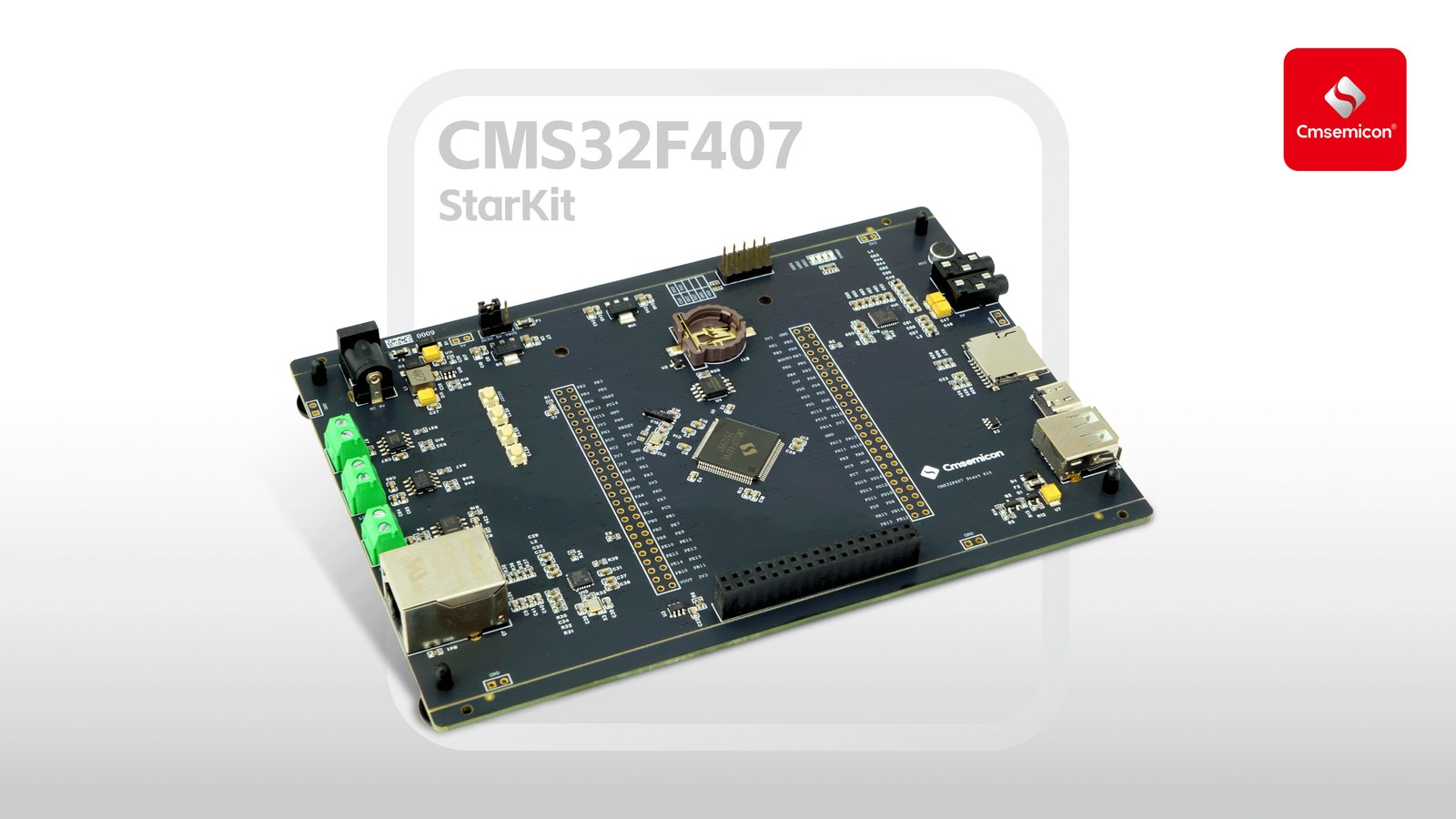
Official CMS32F407 StarKit evaluation-board photograph from the same November 2 news post — Ethernet jack, USB, pin headers, and green terminal blocks around a centrally placed MCU, under the CMS32F407 StarKit label. Vendor product photography of the eval hardware, not a schematic or a die shot.
A rhyme, not a drop-in
Engineers reach for STM32F407 when they want a mid-range M4F with Ethernet, USB, CAN, a camera interface, and enough SRAM to run a protocol stack without immediately adding external RAM. Cmsemicon is pitching the same shape of part: 168 MHz*, 192 KB SRAM*, dual USB*, Ethernet*, DCMI*, SDIO*, a parallel 8080/6800 LCD*, and a motor-friendly timer/PWM set*. If you maintain a China-for-China BOM, or you are dual-sourcing an industrial gateway, a PV inverter controller, a small HMI, or a drone flight computer, that is a reasonable sample request.
What it is not: a documented pin-compatible second source. We have not seen a pinout drawing in the public materials we retrieved that we could overlay on an STM32F407 LQFP64 or LQFP100. We have not seen Cmsemicon claim register-level compatibility, an ST-library shim, or a binary-compatible vector table. The SKU suffixes invite the comparison; they do not complete it. If someone tells you this is a “drop-in clone,” ask them for the pin table and the memory map — and then spin a breakout, because that claim is not in the November 2 note.
The ADC-channel mismatch (16 external channels* in the news copy and on the launch graphic, versus 24 channels at 2 Msps* in the selector table) is a small example of why you want the datasheet PDF, not just the launch page, before you commit a layout. Same for which of the two USB ports are device, host, or OTG, and whether the Ethernet MAC needs an external PHY the way an STM32F407 typically does. Those details are normal datasheet work. They are also exactly the details a rhyme will not answer.
Who the vendor is
中微半导体(深圳)股份有限公司 does business in English as Cmsemicon and lists on the Shanghai STAR Market as 688380.SH. The public site at mcu.com.cn (English under /en) shows a catalog that already spans 8-bit MCU families, 32-bit M0/M0+ and M3/M4 parts — CMS32F103 is the complementary lower tier named in this launch — plus RISC-V, automotive BAT32 devices, SPI NOR flash, analog and touch, and power-drive products. That is the company’s own product tree, not a ranking we audited.
For an overseas buyer the practical point is simpler than the catalog: this is a Shenzhen MCU vendor whose English product pages exist, whose sample-and-kit language is already in the launch note, and whose Western-distributor footprint for this particular series is, as of this writing, not visible on Digi-Key. You are evaluating a China-direct sampling path and a 2027 Q1* volume promise, not a line card you can place through the same buyer who already procures STM32F407.
What changes (and what does not)
- A named 168 MHz* Cortex-M4F with 512/1024 KB Flash* and 192 KB SRAM*, industrial −40 to +105 °C*, 2.0–3.6 V VDD*.
- Four SKUs in LQFP64 / LQFP100* — CMS32F407RET6 (512 KB / 64-pin), VET6 (512 KB / 100-pin), RGT6 (1 MB / 64-pin), VGT6 (1 MB / 100-pin) — whose suffixes rhyme with ST’s F407 density and pin-count letters.
- Peripherals aimed at the same mid-range industrial / HMI / gateway socket — 2×8-ch DMA*; 51 or 82 GPIO*; 3×12-bit ADC (news and launch graphic: up to 16 external channels* / 16-ch 2 Msps*; table: 24 ch @ 2 Msps*) plus 2×12-bit DAC*; 4×USART + 2×UART (table UART = 6); 3×SPI (two I2S-capable); 3×I2C; 2×CAN; 2×USB; Ethernet; DCMI; SDIO; 8080/6800 parallel LCD*.
- Timers — two 16-bit advanced + ten 16-bit general + two 16-bit basic; up to 36 independent PWM*; RTC, RNG, and hardware CRC*.
- Positioned above CMS32F103* as the higher-tier M4F in the same 32-bit matrix, with more compute, memory, DMA, GPIO, display, analog, and comms* per the launch note.
- Intended sockets* — industrial control / FOC motor and motion, industrial robots, IoT / PLC / wireless gateways, smart home, drone flight control, PV inverter / digital power / UPS*.
- Samples, StarKit eval board, SDK, and docs already offered* — volume production and delivery planned for 2027 Q1*.
- A naming and spec parallel with STM32F407 — not a drop-in. No pin, register, or software-compatibility claim appears in the materials we retrieved, and we are not adding one.
- Not a Digi-Key cart item under CMS32F407 as of November 10, 2026. STM32F407 remains widely available there. Ask Cmsemicon for samples. No public price or MOQ.
Bottom line: if you are already fluent in STM32F407-class parts and you need a China-sourced mid-range M4F with Ethernet, USB, CAN, and a display or camera interface, CMS32F407 is a concrete line item with published SKUs, an official StarKit photo, and a sample-now / MP-in-2027-Q1* calendar. Request the board and the PDF. Put it on the comparison matrix next to the ST device you already trust — then spend the real hours on the pinout, the memory map, the USB and Ethernet PHY details, and whether Cmsemicon will ship you engineering samples on a Western PO. The rhyme gets the part onto the shortlist. It does not get it onto the board.