
On August 5, 2026, GigaDevice published a Chinese product note introducing GD32F50MxxG as a high-integration motor-control MCU for humanoid robots, collaborative arms, and dexterous hands. The headline is not a new CPU architecture. It is a package: inside the same outline, the MCU is co-packaged with two GigaDevice analog dies — GD30DR1401, a three-phase gate driver, and GD30AP8604, a four-channel rail-to-rail op-amp — so a joint board does not have to place a discrete driver and a discrete current-sense front end next to the controller.
That is a familiar pain if you have ever tried to hide a field-oriented-control (FOC) stage inside a hollow joint. The PCB is small, the motor bus is typically a 24–48 V low-voltage torque rail, and the analog traces that carry phase current and encoder or resolver signals are exactly the ones that pick up PWM edge noise. A discrete MCU plus gate driver plus op-amps gives you layout freedom you may not have room to use. A co-pack trades that freedom for a shorter analog path and a smaller BOM — if the on-package analog is actually good enough. Every analog number below is a vendor claim until you measure it on your own motor, current shunt, and encoder.
What the launch note actually specifies
The digital side is an Arm Cortex-M33 running up to 252 MHz*, with a hardware FPU, DSP extensions, and an MPU. Memory is quoted as up to 1 MB of Flash* including 192 KB of zero-wait Code-Flash*, plus 128 KB of SRAM* of which 32 KB has ECC*. Twelve DMA channels* are listed to move ADC, PWM, and bus traffic off the core so the CPU can stay on the control loop. On-chip clocks and PLLs* are described as covering both slow, precise positioning and faster dynamic motion — vendor wording, not a plot we reproduced.
The on-package GD30DR1401 gate driver is specified at a 5–20 V supply, 120 V floating voltage*, an integrated bootstrap diode*, and gate drive of 2 A source / 2.5 A sink*, with six dedicated PWM inputs. GigaDevice says that combination is aimed at FOC on 24–48 V low-voltage torque motors and that hardware protection is built in*. Those current and voltage figures describe the driver die, not the motor you can hang on it; a 2 A / 2.5 A gate driver is about switching the FETs, not about delivering 2 A of phase current to the windings.
The on-package GD30AP8604 is a four-channel rail-to-rail op-amp quoted at 11 MHz gain-bandwidth*, 11 V/µs slew*, a built-in RF/EMI filter*, and noise of 8 nV/√Hz at 1 kHz*, on a 2.6–3.6 V supply. The intended jobs are motor current sensing and amplifying the weak differential signals from an encoder or resolver. Rail-to-rail input and output is the vendor’s argument for a wider measurable signal range*. Again: bench numbers from the note, not from an independent characterization.
Around that analog pair, the launch note and the GD32F50M product table list a timer set of five 16-bit general-purpose timers, two advanced timers, two basic timers, and one 32-bit high-precision timer, plus watchdog and RTC. Complementary PWM is described as tying directly to the on-package driver for a three-phase brushless stage. Analog conversion is three 12-bit ADCs — 15 channels on the QFN80 SKU and 20 channels on the BGA100 SKU, which matches the news note’s “15–20” range — plus one high-speed comparator and one 12-bit DAC. The comparator is called out for hardware-speed fault cutoff*: a stall or overload is supposed to drop the power stage without waiting for the CPU to notice. Operating ambient on the selector is −40 to 105 °C.
The communications complement is built for multi-joint cabling rather than for a display-heavy HMI: two CAN-FD* controllers, USB 2.0 Full Speed*, three SPI, two I²C, and five U(S)ART (the product table splits that as 3+1 USART+UART on the QFN and 3+2 on the BGA). GPIO counts are 37 on the 80-pin QFN and 54 on the 100-ball BGA. There is no EtherCAT slave controller on this part — that lives on the same-day sibling discussed below.
Samples through GigaDevice sales — this exact SKU is not one we could find on Digi-Key. GigaDevice is a brand overseas engineers already buy there (serial flash and older GD32 MCUs show up in the catalog). Searches on November 9, 2026 for GD32F50MMGO7G and GD32F50MVGK7G did not return matching Digi-Key product pages. The August 5 note says the 8 × 8 mm QFN80, GD32F50MMGO7G, is open for sample requests with mass production planned for December 2026*, and that the 7 × 7 mm BGA100, GD32F50MVGK7G, would start sampling in early November 2026* with volume supply around March 2027*. We have not seen a public distributor cart for either outline. The path printed on the news page is to contact GigaDevice sales through gigadevice.com.cn (English at gigadevice.com and the MCU portal GD32MCU.com) and ask for samples plus the FOC motor reference project, joint-drive development kit, and evaluation board. No public pricing, minimum order, or qualification grade was published, and we are not inventing any.
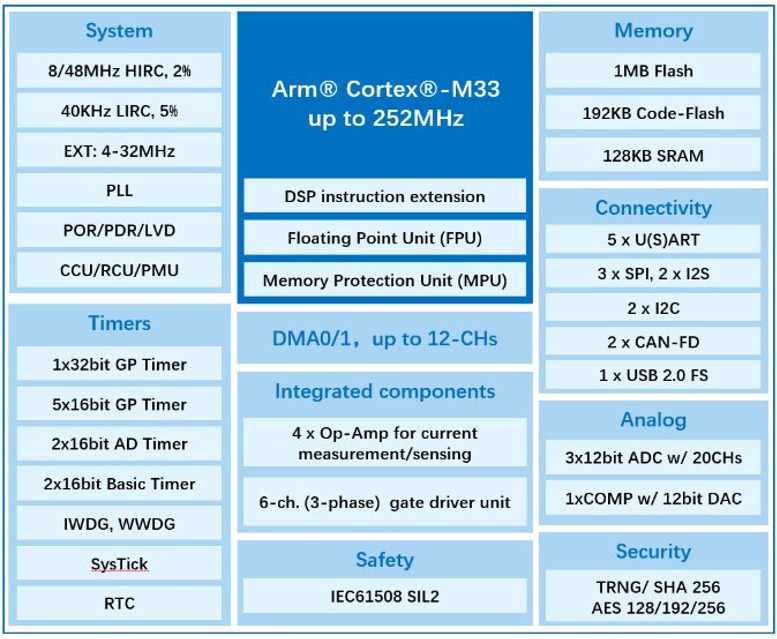
Official block diagram from the same August 5 news post, calling out the Cortex-M33 (up to 252 MHz), the integrated 4× op-amp block, and the 6-channel three-phase gate-driver unit, alongside memory, timers, 2× CAN-FD, USB FS, triple 12-bit ADCs, IEC 61508 SIL2, and TRNG / SHA-256 / AES. Vendor diagram, not a die photo.
The analog bet inside a hollow joint
GigaDevice’s own framing is that robot joints suffer from too many discrete chips, a tight cavity, mediocre sense-signal integrity, and serious EMI. Co-packaging the driver and the op-amps is the proposed answer: fewer parts on the BOM, less analog routing on a cramped board, and complementary PWM that does not have to leave the package to reach the gate driver. For a dexterous-hand finger actuator or a micro-joint, the outline argument is straightforward — 8 × 8 mm QFN80 or 7 × 7 mm BGA100 is a different conversation from a controller card that also has to place a standalone 3-phase driver and a quad op-amp.
The 120 V floating rating* is how the vendor gets to “point this at a 24–48 V industrial low-voltage motor without an extra intermediate rail.” That is a packaging and voltage-rating claim, not a statement that every 48 V servo FET stage will be happy with a 2 A / 2.5 A gate-drive strength* or with the layout constraints of an 8 mm QFN. The op-amp noise, bandwidth, and RF/EMI-filter lines* are the ones that decide whether current-shunt and resolver signals come back clean enough for a high-rate FOC loop. Those are exactly the figures you should treat as a starting hypothesis and then verify on hardware.
芯东西 / Zhidx, writing the same day, reported a vendor comparison in which the 252 MHz M33* leads unnamed competitors “A, B, and C” on DMIPS and CoreMark and can “stably output a dual-axis 40 kHz switching frequency.” That is the dual-axis 40 kHz PWM FOC capability* circulating with the launch. It does not appear in the official news note we retrieved, and no scope shot or load condition was published with it. Treat it as a vendor bench claim relayed by the trade press.
Safety claims, packages, and the same-day sibling
On the security side the note lists a hardware module with a true random-number generator, a SHA-256 hash unit, and an AES-128/192/256 engine*, plus an EFUSE region for locking joint calibration parameters*. Secure boot and secure firmware update (SBSFU)* are mentioned, with a claim that the product and its development process follow the EU Cyber Resilience Act and IEC 62443*. Separately, the chip is said to have IEC 61508 SIL2 functional-safety certification*, with an MCU hardware self-test library that can diagnose core, memory, analog, and driver faults and cut motor output*. We did not retrieve the certificate PDFs; those lines stay asterisked.
Two outlines are on the selector. GD32F50MMGO7G is the 8 × 8 mm QFN80, positioned as the micro-joint option, with samples already open as of the August note and mass production planned for December 2026*. GD32F50MVGK7G is the 7 × 7 mm BGA100, scheduled to start sampling in early November 2026* and to reach volume around March 2027*. The BGA brings more I/O (54 vs 37) and more ADC channels (20 vs 15); it also asks you to live with a fine-pitch ball grid inside a joint that may prefer a QFN for assembly and inspection. Pick the outline for the cavity and the factory you actually have, not for the more impressive-sounding ball count.
The same afternoon, GigaDevice also introduced a sibling that is easy to mix up with this part and should not be. The GD32H77R is a 600 MHz Cortex-M7* in a 9 × 9 mm BGA169*, with an on-chip EtherCAT slave controller*, industrial encoder protocols (Zhidx lists EnDat, BiSS-C, and Tamagawa)*, and a resolver-to-digital block*. That is the higher-axis, industrial-network motion MCU — useful context if you are partitioning a humanoid between a networked joint computer and a tight servo driver, and not a co-packaged gate-driver part. It is not the hero of this note.
Who the vendor is
GigaDevice Semiconductor Inc. (兆易创新科技集团股份有限公司) dates its founding to April 2005, with group headquarters in Beijing and listings on the Shanghai and Hong Kong exchanges (603986.SH, 3986.HK). The company describes itself as a fabless supplier built around memory, microcontrollers, sensors, and analog. GD32 is pitched as China’s largest Arm MCU family* and as the first domestic general-purpose line on Cortex-M3, M4, M23, M33, and M7, as well as the first RISC-V 32-bit general-purpose MCU series* — company chronology, not a ranking we audited. Cumulative MCU shipments are given as more than 2.5 billion* units, with more than 20,000 customers* and 81 series / 800+ SKUs*.
Zhidx, citing MCU marketing lead Li Xiaojian (李孝剑), added that 2025 MCU shipments were about 500 million* units and that humanoid-robot-related MCU shipments in the first half of 2026 were about 3 million* devices, with the second half expected to grow further*. Those are existing GD32 sockets, not a shipment claim for GD32F50MxxG, which the same story describes as still in early market introduction. For an overseas motion or humanoid team the practical point is simpler: this is a vendor whose catalog you can already find on Western distributors — just not, as of this writing, under these two new SKUs.
What changes (and what does not)
- A co-pack, not a faster core by itself — Cortex-M33 up to 252 MHz* with FPU, DSP, and MPU, plus on-package GD30DR1401 (3-phase gate driver) and GD30AP8604 (4-ch rail-to-rail op-amps).
- Aimed at 24–48 V FOC in tight joints — driver supply 5–20 V, 120 V floating*, bootstrap diode*, 2 A source / 2.5 A sink*, six dedicated PWM inputs, complementary PWM wired to the on-package driver*.
- Sense path is the other half of the bet — op-amps at 11 MHz GBW*, 11 V/µs*, RF/EMI filter*, 8 nV/√Hz at 1 kHz*, 2.6–3.6 V, for current shunt and encoder/resolver weak signals*.
- Memory and convertors — up to 1 MB Flash* (192 KB zero-wait Code-Flash*), 128 KB SRAM* (32 KB ECC*), 12 DMA channels*, 3× 12-bit ADC (15 ch QFN / 20 ch BGA), hardware comparator for fast fault cutoff*, 12-bit DAC.
- Joint-oriented I/O, not EtherCAT — 2× CAN-FD*, USB FS*, 3× SPI, 2× I²C, five U(S)ART; 37 I/O on QFN80, 54 on BGA100. EtherCAT and encoder-protocol blocks sit on the same-day GD32H77R (600 MHz M7*, 9 × 9 mm BGA169*), not on this part.
- Dual-axis 40 kHz PWM FOC* — reported by Zhidx as a vendor comparison result; not printed in the official news note we retrieved, and not a number we measured.
- Safety and crypto are vendor claims — IEC 61508 SIL2* plus TRNG / SHA-256 / AES* and SBSFU*; CRA and IEC 62443 alignment* as stated. Certificate PDFs not retrieved here.
- Two packages, two calendars — GD32F50MMGO7G 8 × 8 mm QFN80, samples open, MP planned December 2026*; GD32F50MVGK7G 7 × 7 mm BGA100, sampling from early November 2026*, MP around March 2027*.
- Not a Digi-Key cart item under these SKUs as of November 9, 2026. Ask GigaDevice sales for samples and the FOC reference / joint-drive kit. No public price or MOQ.
Bottom line: if you are stuffing a 24–48 V FOC stage into a humanoid joint, a dexterous-hand actuator, or a small cobot servo, a single outline that already ties complementary PWM to an on-package gate driver and four current-sense / encoder op-amps is the kind of part you request as a sample — then you probe the analog yourself. GigaDevice is not a new name on a Western line card. This particular SKU just is not on that card yet, and the 40 kHz dual-axis FOC line* remains a vendor bench until it shows up in your own trace.