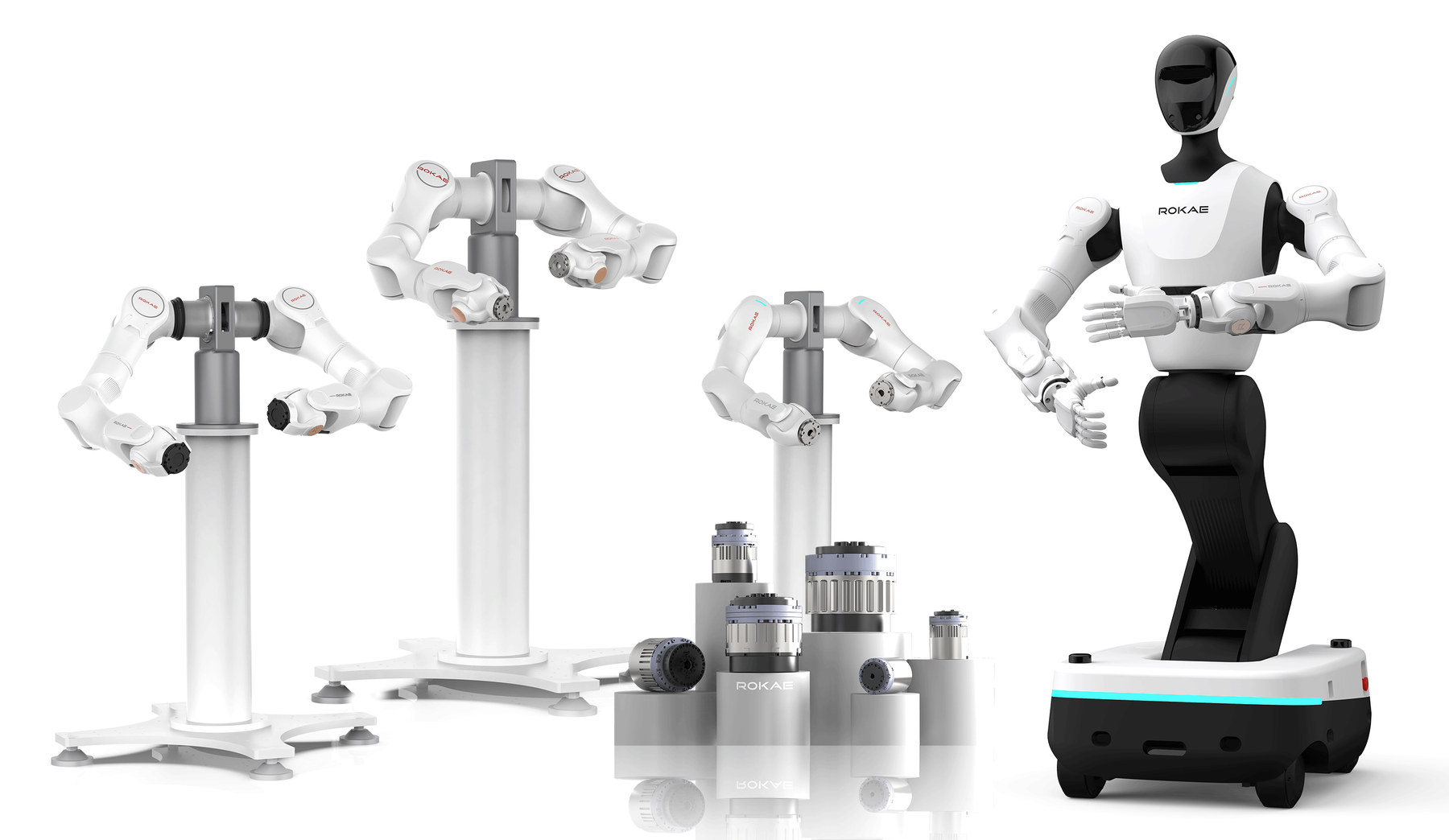
Most dual-arm and wheeled-humanoid stacks still split the problem across two boxes: a GPU computer that runs perception and a planning model, and a separate real-time controller that closes the force and motion loops over EtherCAT. That split is boring, well understood, and the source of a lot of late-night clock-domain debugging. What ROKAE and D-Robotics announced on November 11 is narrower than a new robot, and more interesting than a partnership logo: ROKAE says its iNex “cerebellum” — whole-body control, force control, and the real-time I/O — now runs on the same Sunrise S600 that is supposed to host the AI brain, with no extra motion-control box*.
The primary sources are ROKAE’s own November 11 news post and a D-Robotics press note carried the same morning by 中华工控网. 界面新闻 and 北京商报 ran shorter versions. Treat the latency numbers, the integration-time savings, and the “already deployed” wording as vendor claims until you have a boot image, a wiring diagram, and a jitter plot taken on S600 hardware — not on the NVIDIA boards iNex already supported.
The SoC has been on the page since last year
None of this requires you to pretend the silicon is new. D-Robotics introduced the S600 as an embodied-AI compute platform in November 2025, and the current RDK S600 developer-kit manual is explicit about why the board exists: a heterogeneous design that is supposed to handle perception inference and real-time motion control together, “reducing the size and complexity of the control system.” The useful numbers, as that official page states them today:
- 18× Arm Cortex-A78AE at 2.0 GHz*.
- 6× Arm Cortex-R52+ in the MCU domain, described as 1× DCLS and 2× Split-Lock*. That is the kind of lockstep / split-lock wording you want to see if a vendor is serious about putting a 1 kHz force loop next to a large model, but it is still a documentation claim, not a measured safety case.
- 4× BPU Nash cores, “up to 560 TOPS”*. The page does not, in the section we retrieved, spell out the integer type or a sparse-versus-dense footnote next to that 560. Ask before you put it in a comparison table.
- Memory: 32 or 64 GB LPDDR5, 256-bit, up to 6400 MT/s*; storage 64 or 256 GB UFS 3.1*, plus an M.2 Key M slot for NVMe.
- I/O that actually matters on a robot: two 10 GbE and three 1 GbE ports (one of the 1 GbE ports is in the MCU domain)*, six USB 3.2 host ports, MIPI and camera expansion connectors, and a generous helping of CAN on both the main and MCU sides*. The kit is listed at 140 × 123 × 78 mm* and is powered at 12–28 V*.
That MCU-versus-main split is the part to keep in your head when you read this week’s announcement. If iNex’s 1 kHz loop and the 20 μs communication-jitter figure* are going to survive contact with a 560-TOPS inference workload, they almost certainly have to live on the R52+ side, with a well-defined bus to the A78AE / BPU side — not as “the model and the current loop share a Linux scheduler.” The announcement does not give you that diagram for the S600 port. The kit photo and the connector map at least show that the hardware was laid out with two domains in mind.
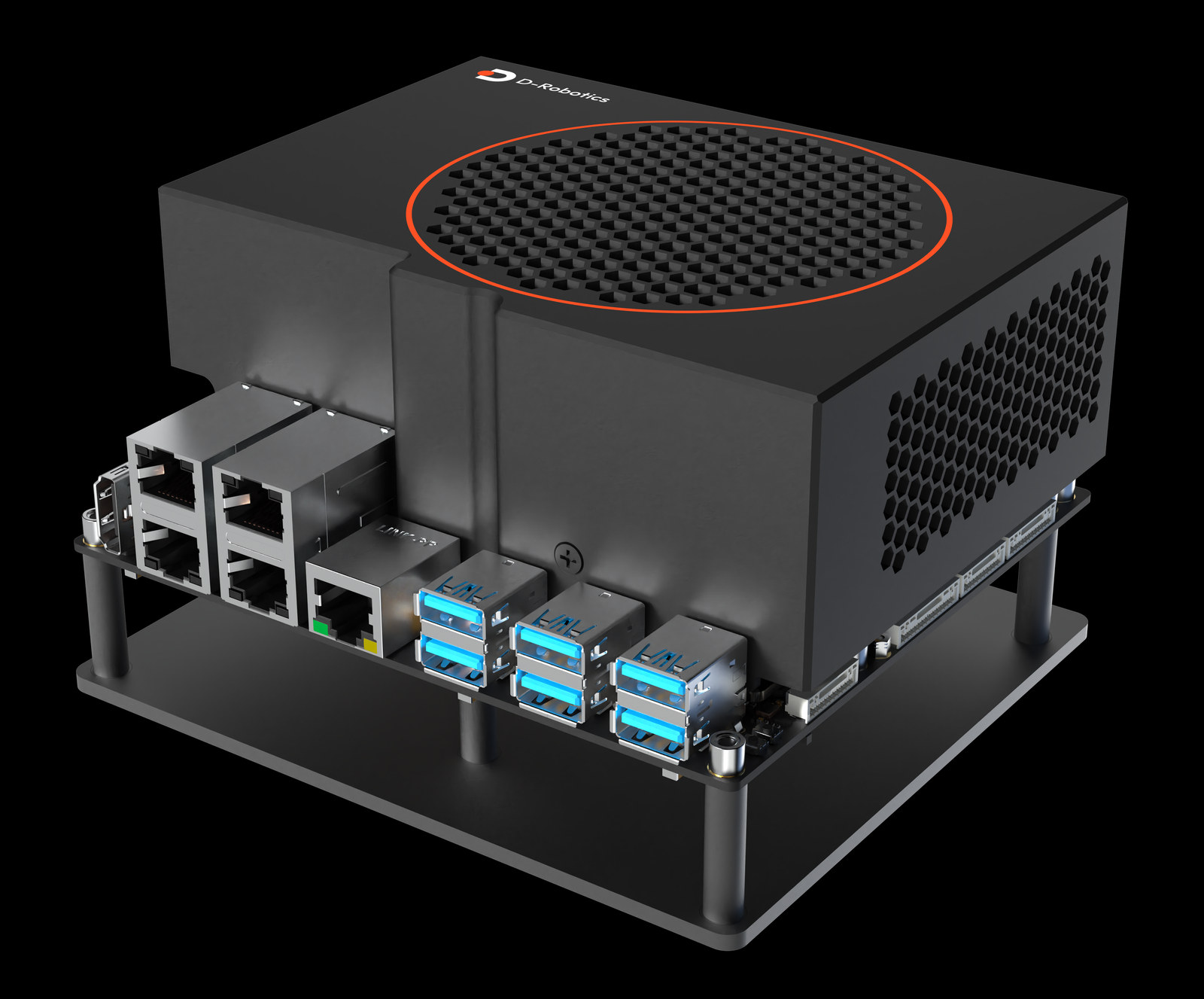
Official product photograph from D-Robotics’ RDK S600 kit manual: the developer kit that carries the Sunrise S600. This is a real product shot of the compute box, not a render of a robot. The kit is how most outside engineers would actually get the SoC in their hands.
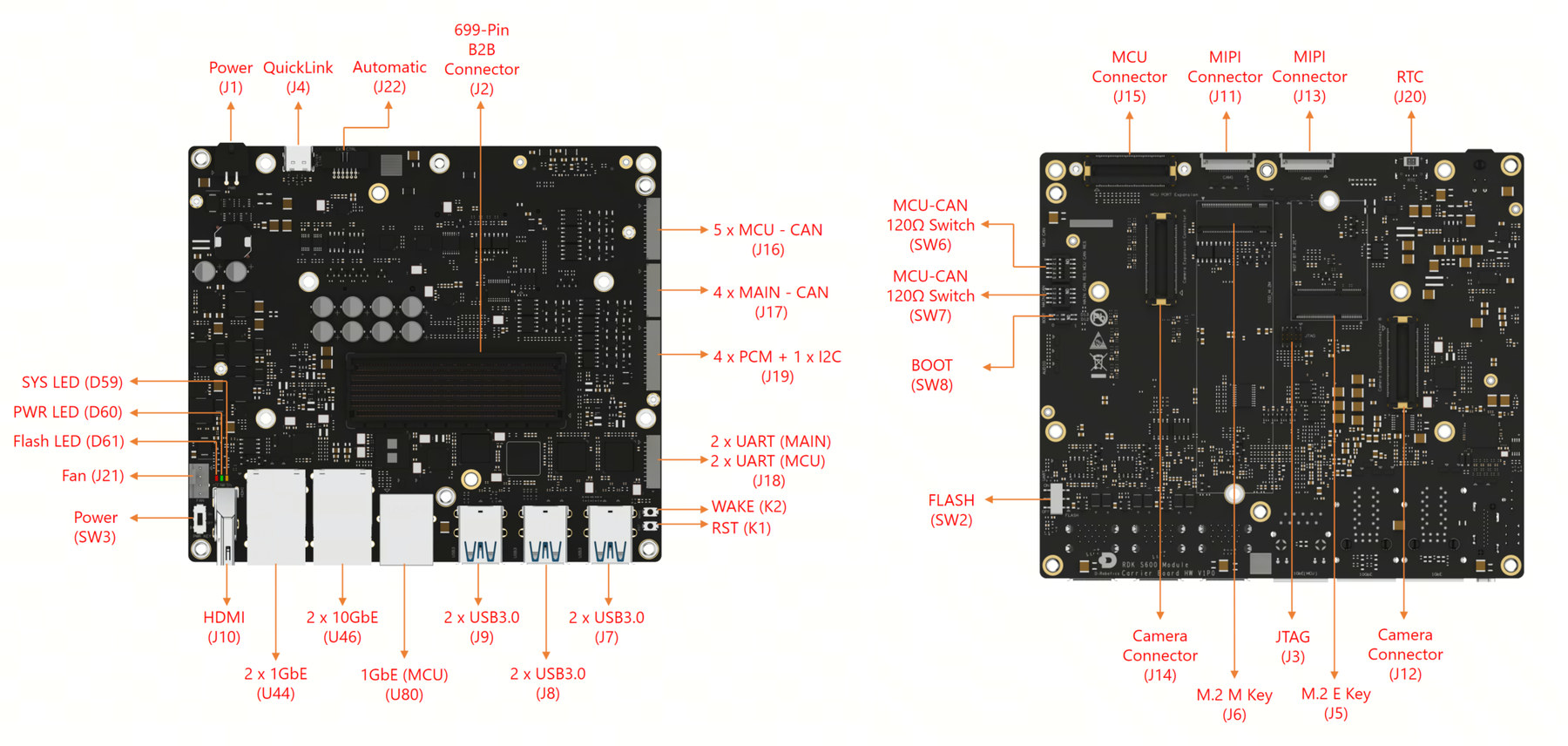
Official connector map from the same RDK S600 manual, showing the main-domain and MCU-domain Ethernet, CAN, UART, MIPI, and camera connectors. This is the I/O story behind the “one box” claim: there is a real MCU domain on the board, with its own network and CAN, not just a single Linux USB tree.
iNex already ran on Orin and Thor
ROKAE’s own post is careful, in one important sentence, about what is actually new. It says iNex had already been adapted to NVIDIA Orin / Thor and other mainstream compute platforms, and that S600 “further enriches the choice of compute,” still with no extra motion-control box*. In other words, the All-in-One design — one controller for the arms, waist, head, and chassis, sitting next to the AI brain — is the iNex pitch in general. This week is a port of that stack onto a Chinese SoC that was designed for the same split, not the invention of a new control architecture.
That reading is reinforced by the official iNex diagram ROKAE published with the announcement. The slide still labels the “brain compute platform” as NVIDIA Orin / Thor. It lists Ubuntu 20.04 / 22.04 / 24.04, PREEMPT_RT, ROS, DDS, and an SDK, EtherCAT out to the force-controlled arms, and a 玄玑 HSA torso joint*. It also repeats the marketing numbers that will get copied into pitch decks: cerebellum integration in “≤2 weeks,” “about 6–9 months” of low-level work saved, and a 30–50% R&D-efficiency gain*. Those are vendor estimates. They are not S600-specific measurements, and they were already on the iNex slide before this port.

Official ROKAE iNex graphic from the company’s November 11 news post (higher-resolution copy in the D-Robotics press package). Note that the labeled compute platform on the slide is still NVIDIA Orin / Thor. S600 is the newly added option; it is not yet drawn in place of the NVIDIA box on this official figure.
The other iNex numbers in the same post, all vendor: 20 μs-class communication jitter*, a 1 kHz real-time closed loop*, EtherCAT, and a force-control accuracy of 0.05 N·m*, with impedance, admittance, and hybrid force/position modes*. There is an SDK, native ROS 2 support, and a sim-to-real path*. The useful engineering question is not whether those sentences exist. It is whether they were re-measured on the S600 — and whether the R52+ MCU domain is doing the 1 kHz work — or whether a number taken on Orin was pasted into a press release about a new SoC.
The machines the port is aimed at
The announcement names two product lines, not a one-off lab cart. The 太白 Taibai AR series is ROKAE’s seven-degree-of-freedom humanoid force-controlled arm, with a torque sensor in each joint, aimed at compliant insertion, lead-through teaching, and contact-rich work in 3C and precision assembly*. The form called out this week is the AR5 dual-arm integrated cell. The 逐星 Zhuxing H is the wheeled dual-arm humanoid: an omnidirectional base, two arms, multimodal sensing, and SLAM, pitched for moving between stations rather than standing at one*. Official English product pages already exist for the AR arm and, in Chinese, for the Zhuxing H; this week’s note is that both are supposed to take a unified S600-based iNex fit.
ROKAE also leans on a delivery number that is easy to over-read. On September 29, 2026, the company said its 10,000th humanoid force-controlled arm had been shipped*. The D-Robotics note repeats a global installed-base claim of more than 1,000 enterprise customers and a sales-and-service network in more than 40 countries and regions*, plus a line about more than half of China’s “TOP20” embodied-AI firms using the arm*. Those are company figures about the existing arm business. They are not evidence that 10,000 S600-based controllers are already in the field. The honest status is: a shipping industrial arm family, a listed company, and a newly announced compute option.
You can inquire about an RDK S600 kit, and you can buy ROKAE arms. We did not find a public “AR5 + S600” or “Zhuxing H + S600” catalog SKU, and we did not find a Digi-Key or Mouser click for either. D-Robotics publishes a full developer-kit manual, connector drawing, and architecture description; the kit has been offered as a commercial board, not a paper product. ROKAE is a Hong Kong-listed robot maker (3752.HK) with English product pages and, by its own account, customers outside China. That is a real inquiry path if you already use ROKAE arms or if you are qualifying a China-sited compute option next to Orin or Thor. It is not the same as adding a finished S600 robot to a cart. Ask for the S600 image, the ROS 2 / PREEMPT_RT package list, the EtherCAT topology, and a jitter-and-isolation measurement taken on S600 — including what happens to the 1 kHz loop when the BPU is busy. Then decide whether “no extra box” is a wiring win you can take to the floor, or just a press-cycle port.
What this changes, and what it does not
It does not dethrone Jetson, and it does not make S600 a drop-in for every iNex customer who is already on Orin or Thor. ROKAE said as much, by framing S600 as another compute choice in an already-portable stack. A press-package photograph of the AR series doing constant-force surface tracking, and a studio lineup of the Zhuxing H, also do not tell you cycle time, payload, or ISO safety for a cell that has actually been retimed around this SoC.
What it does change is the answer to a more specific question: if you are already looking at D-Robotics silicon — because of supply, because of a China-sited line, or because the R52+ MCU domain is a better story than a single Linux box — is there a shipping industrial motion stack that claims to run on it, with ROS 2 and whole-body force control, aimed at robots you can at least request a quote for? Until this week the honest answer, for most overseas engineers, was “maybe, if you write the cerebellum yourself.” ROKAE is now saying it has done that port on the AR5 and the Zhuxing H. That is worth a phone call if those machines were already on your shortlist. It is not, by itself, a reason to rip out a working Orin controller.
The homework is ordinary. Ask which S600 SKU (32 versus 64 GB, which UFS option) they booted. Ask whether the 1 kHz loop and the 20 μs jitter number were re-measured on that SKU. Ask how the MCU domain and the BPU domain are isolated when a model is running. Reconcile the 560 TOPS line with the precision and sparsity the datasheet actually quotes. Then decide whether one fewer box is worth the platform risk — or whether iNex-on-Orin was already the product, and S600 is just another compile target.