
If you work in image tools, this is the drop that looks, at first glance, like a usable open alternative to closed 4K generators. The Hugging Face card and the November 11 research blog describe a model built on the H3 architecture with the audio branch removed. Text and reference images are packed into one stream. The diffusion transformer is dense, 50 layers, hidden size 5376, 56 heads; weights are mostly BF16, with the embedding, timestep, and output layers in FP32. The checkpoint is distilled to 6 sampling steps (6 NFEs) and does not use classifier-free guidance — local serving docs say num_inference_steps must be 6 and guidance_scale must be 1, or the server returns HTTP 400.
Resolution is the product hook. The card says the working range is about 4–20 MP, with the best results around 16 MP, and lists common sizes from 4096×4096 (1:1) to 6272×2688 (21:9), generated directly rather than upscaled. The blog’s speed claim is a full-resolution 4K image in under 10 seconds, “up to 5×” mainstream alternatives* — company wording, not a number we timed. Chinese coverage on November 10–11 (第一财经, 新浪科技) repeated the same 10-second / 16 MP line.
Local disk weight is the other half of “open.” The H3-Image repo lists the BF16 DiT at 68.65 GB. The text encoder is not in that repository: model_index.json loads it from MiniMaxAI/MiniMax-H3, another 66.7 GB. The image VAE is about 2.34 GB. Official serving recipes name SGLang, vLLM-Omni, diffusers, LightX2V, and ComfyUI. The vLLM-Omni note lists hardware such as NVIDIA H200, RTX PRO 6000 Blackwell, and AMD Instinct MI350X. Hugging Face also listed dozens of community quantizations at the time we looked — we did not run them. This is a cluster-class checkpoint, not something you casually load on a 24 GB card.
The license is the story for overseas readers
The file on the repo is the MiniMax-H3-Image Community License Agreement, dated November 10, 2026. The licensor named in the text is Nanonoble Pte. Ltd. “Applicable Territory” is defined as worldwide, excluding the Excluded Territories: the EU, the UK, Korea, and the United States. Rights to use, reproduce, distribute, create derivatives, and modify the Materials are granted solely within that territory.
Section V is stricter than a “don’t download the weights in California” footnote. It says you may not use, reproduce, modify, distribute, or display the Works or any of their Outputs outside the Applicable Territory, and that any such use is not authorized by the agreement. The Acceptable Use Policy repeats “use outside the Applicable Territory” as item 1. If you are in one of the excluded places and want to deploy the models, MiniMax says you may contact them about a separate license “based on robust controls and guardrails.”
There is also a commercial gate even inside the allowed territory. Section IV requires prior written authorization — requested through platform.minimax.io/console/license — if your annualized revenue (with affiliates) exceeds $1 million, or if you provide a Hosted Service to third parties. Commercial UIs must prominently display “MiniMax-H3-Image.”
One more license footnote: the optional prompt-expander, MiniMax-H3-Image-PE (~17.9 GB NVFP4), is described as derived from Qwen3.8-27B (Apache 2.0). The H3-Image license says the PE model is nevertheless part of H3-Image and is subject to the same Community License.
Weights: not under this license if you are in the US, the EU, the UK, or Korea — and “displaying outputs” is in the restriction, not only downloading the files. Elsewhere, the Community License is a starting point, not OSI open source; read the file before you fine-tune or host, and budget for the $1M / Hosted Service authorization. The official API is a different contract. Global docs live at platform.minimax.io (api.minimax.io); China at platform.minimax.cn / api.minimax.cn. Consumer surfaces listed on the card are Hailuo (hailuoai.video global, hailuoai.com in China) and MiniMax Code / Agent. We did not independently verify whether MiniMax will sell API access to every excluded-territory account — check the platform terms and your own login rather than assuming the weights ban automatically follows the API, or the other way around.
What the official API actually costs
This is the path most overseas teams will try first, if their account is accepted. Image generation is billed in USD on the global pricing page, in tokens, not as a flat “per image” SKU. Listed unit prices:
- MiniMax-H3-Image (Standard): $2.30 input text / $1.50 input image / $3.80 output image, per million tokens.
- MiniMax-H3-Image-Highspeed: $2.30 / $3.00 / $7.60 per million tokens.
- Standalone prompt enhancement, H3-Image-Context-IR: $2.30 input per million tokens (the image-generation guide also has a default prompt-enhancement path on text-to-image; edits always enhance).
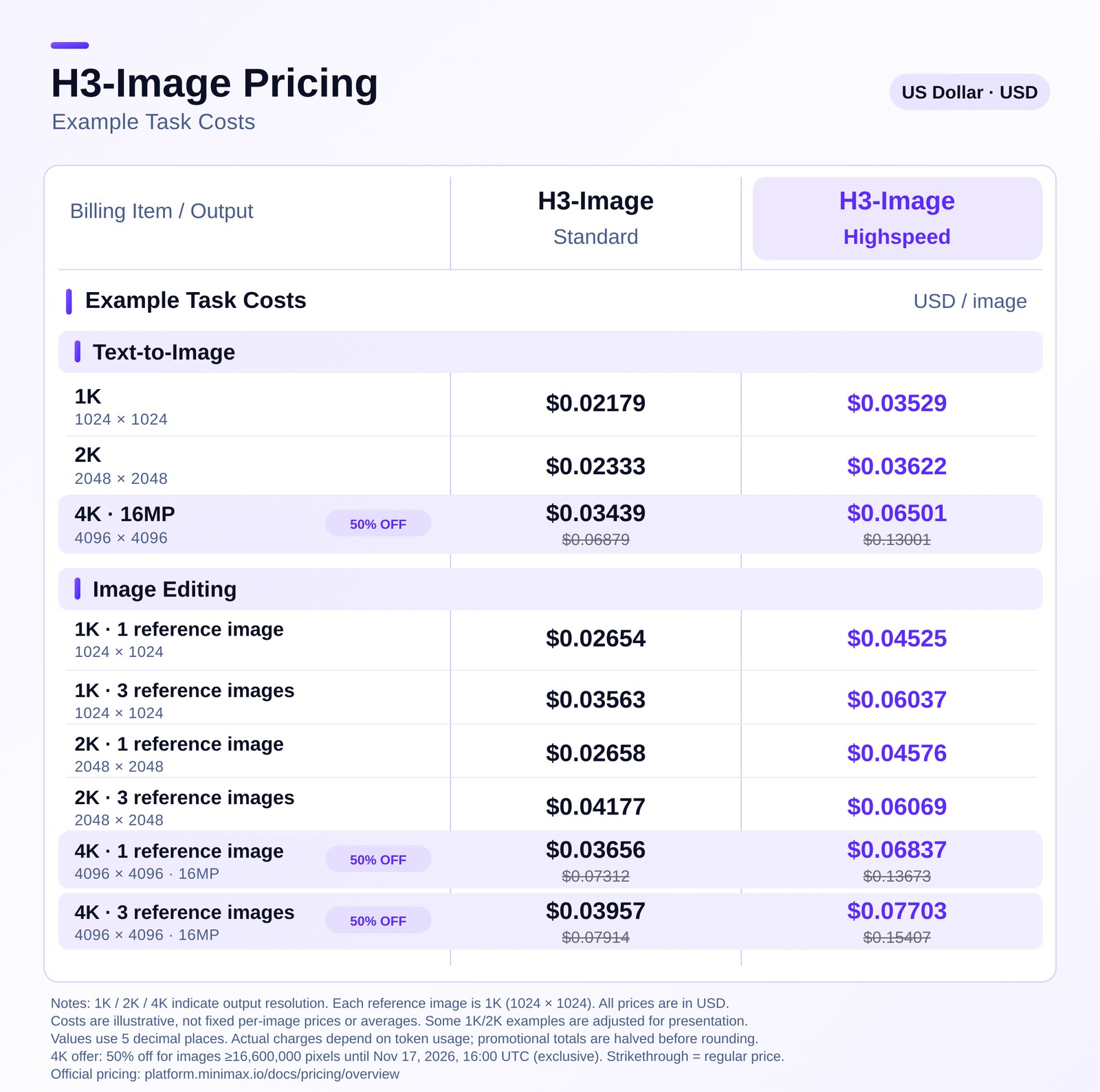
Official MiniMax “H3-Image Pricing — Example Task Costs” chart from the November 11, 2026 research blog. The same figures appear on platform.minimax.io/docs/pricing. These are company illustrative examples, not a price we independently metered.
The pricing page’s own worked examples (it warns that actual charges move with text-token count, including tokens from prompt enhancement) include:
- Standard text-to-image: about $0.02179 at 1K (1024×1024), $0.02333 at 2K (2048×2048), and $0.06879 at 4K (4096×4096) — $0.03439 with the 4K promotion.
- Highspeed text-to-image at 4K: $0.13001 regular, $0.06501 on the promotion.
- Standard image edit, one 1K reference → 4K output: $0.07312 regular, $0.03656 on the promotion.
The limited-time offer, as written on the pricing page, is 50% off the total request cost for both H3-Image and H3-Image-Highspeed when the final delivered image has at least 16,600,000 pixels, until November 17, 2026, 16:00 UTC (exclusive). Endpoints are the usual pair: POST /v1/images/generations and POST /v1/images/edits (1–16 references). A Highspeed request uses the same parameters with model set to MiniMax-H3-Image-Highspeed. Speed claims for the API — Standard “1.5–2×” and Highspeed “3–4×” versus “mainstream alternatives,” and list pricing “50–70%” of those offerings — are MiniMax’s, not ours*.

Official MiniMax “Photorealistic photography” showcase strip from the model-card assets (assets/showcase/photo.jpg). Company samples of what the checkpoint is meant to look like — again, not images we generated.
Honest caveats
- Territory — the Community License is not a global open-weight grant. US, EU, UK, and Korean use of the Works and their outputs is outside the license as written.
- Not OSI open source — revenue and Hosted Service triggers, plus an acceptable-use policy that includes a military-use ban and other restrictions. Read the file; this page is a briefing, not legal advice.
- Self-host cost — on the order of two ~66–69 GB BF16 components plus a VAE. Official recipes assume data-center GPUs. Quantized forks exist; we have no numbers for them.
- Vendor benches — sub-10-second 4K, “5×,” “strongest instruction following among open-weight models,” and the API speed/price multiples are company claims. We did not rerun them.
- API ≠ weights — dollar prices above are from MiniMax’s global pricing page. Whether a given overseas account can actually call the API is a platform-terms question, not something this page can certify.
For an overseas engineer, the useful split is simple. If you are in the excluded territories, do not treat the Hugging Face repo as a free local 4K engine; ask MiniMax about a separate license, or evaluate the official API under its own terms. If you are elsewhere, the weights are real and the serving recipes are public — but budget cluster GPUs, read Section IV before you productize, and keep the 10-second marketing line in the asterisk column until you have your own traces.