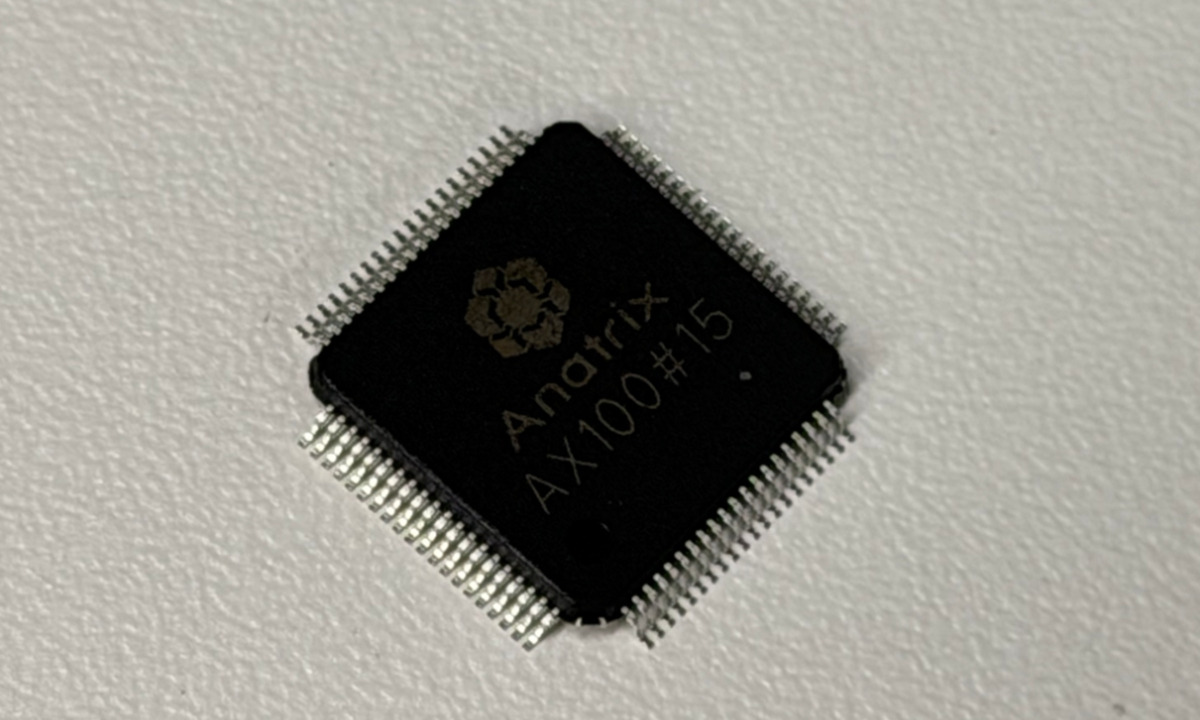
If you write robot controllers, wireless baseband, or second-order training loops, you already spend a surprising fraction of the budget on Ax = b. Digital silicon does that job by turning inversion into a pile of matrix–vector multiplies — classically on the order of O(n³) operations. Science and Technology Daily used a 512×512 illustration: about 500 million multiply-adds, tens to hundreds of microseconds on conventional hardware. That example is a complexity sketch in the press report, not a published AX100 benchmark at 512×512*.
Anatrix’s pitch is the other way around. CEO Xiang Rui (向锐) told the paper that the matrix equation is mapped onto a circuit; once the circuit settles, you read the answer once, with no iteration*. The company website, anatrix.com, puts the same idea in English: “solves matrix equations in a single step with constant complexity.” Constant complexity is the interesting claim for an overseas engineer — it would mean the analog settle time does not grow the way a digital LU factorization does — and it is still a company claim, not a public timing table versus matrix size*.
What was actually announced on November 15
The news is a tape-out plus a first test readout, not a production SKU. Science and Technology Daily (张盖伦, 17:41 Beijing time on November 15) is the primary write-up we used; Beijing Daily republished it, and Securities Times carried a shorter version the same evening. The chip is described as a “fully integrated one-step matrix-equation analog computing chip,” and as the first of its kind*. “World’s first” is the company’s and the paper’s wording. Analog matrix solvers and RRAM in-memory compute have a long academic trail; what Anatrix is asserting is a fully integrated, one-step product-style chip, not that nobody has ever solved Ax = b in analog.
The published company test points, all asterisked:
- Latency: a single matrix-equation solve in under 100 ns*.
- Energy: about 80 mW per solve*. (The report does not say whether that is average power during the settle, energy converted into a power figure, or a board-level number.)
- Training-style tests: a 2.93 million-parameter autoencoder and a 2.72 million-parameter transformer. The second-order optimization scheme used in those experiments cut the “training update cost” by 92% and 56% respectively*. These are small models, not a foundation-model run.
- Embodied AI: end-to-end motion control and planning sped up 150–500%; 3D reconstruction and SLAM kernels sped up 200–500%*. Wide ranges, no public methodology.
- Wireless: on a 128×128 channel Gram matrix, “equivalent throughput” 20–207× and “equivalent energy efficiency” 27.6–61.3× versus existing digital ASIC and GPU baselines in the company’s evaluation*.
- Process: “mature” manufacturing, not an advanced node* — the node itself was not named.
Missing from the November 15 brief, and worth asking before you get excited: maximum matrix size on AX100, numeric precision, how A and b are written onto the array, I/O time versus the sub-100 ns settle, whether the 80 mW figure includes converters, and what software stack a customer would actually call.
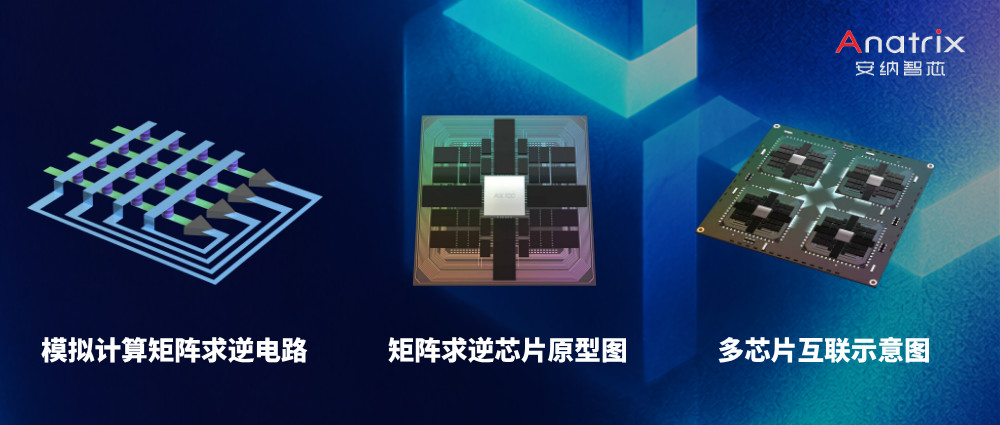
Official Anatrix graphic from the company’s September 19, 2026 company-introduction post: analog matrix-inversion circuit (left), a prototype photograph (center), and a multi-chip interconnect schematic (right). Company artwork; the center panel is presented as a prototype photo, not a die shot we can independently measure.
Keep the Nature paper and the product chip in separate piles
The scientific result everyone is hanging this on is “Precise and scalable analogue matrix equation solving using resistive random-access memory chips,” published October 13, 2025 in Nature Electronics (open access). The corresponding author is Zhong Sun at the Institute for Artificial Intelligence, Peking University, with co-authors including Yimao Cai and Ru Huang. The paper is not a product announcement for AX100.
What that paper actually reports: a precise, scalable analogue inversion method on 3-bit foundry RRAM chips, combining a low-precision analogue inversion with a high-precision analogue matrix–vector multiply, plus a block-matrix algorithm. The experiment that carries the precision claim is 16×16 real matrices solved to 24-bit fixed-point (the authors say this is comparable to FP32). A massive-MIMO detection example reached digital-FP32-comparable performance in three iterations. The authors’ own benchmarking language is that the approach could offer about 1,000× throughput and 100× energy efficiency versus then-current digital processors at the same precision — a paper estimate, not an AX100 measurement*.
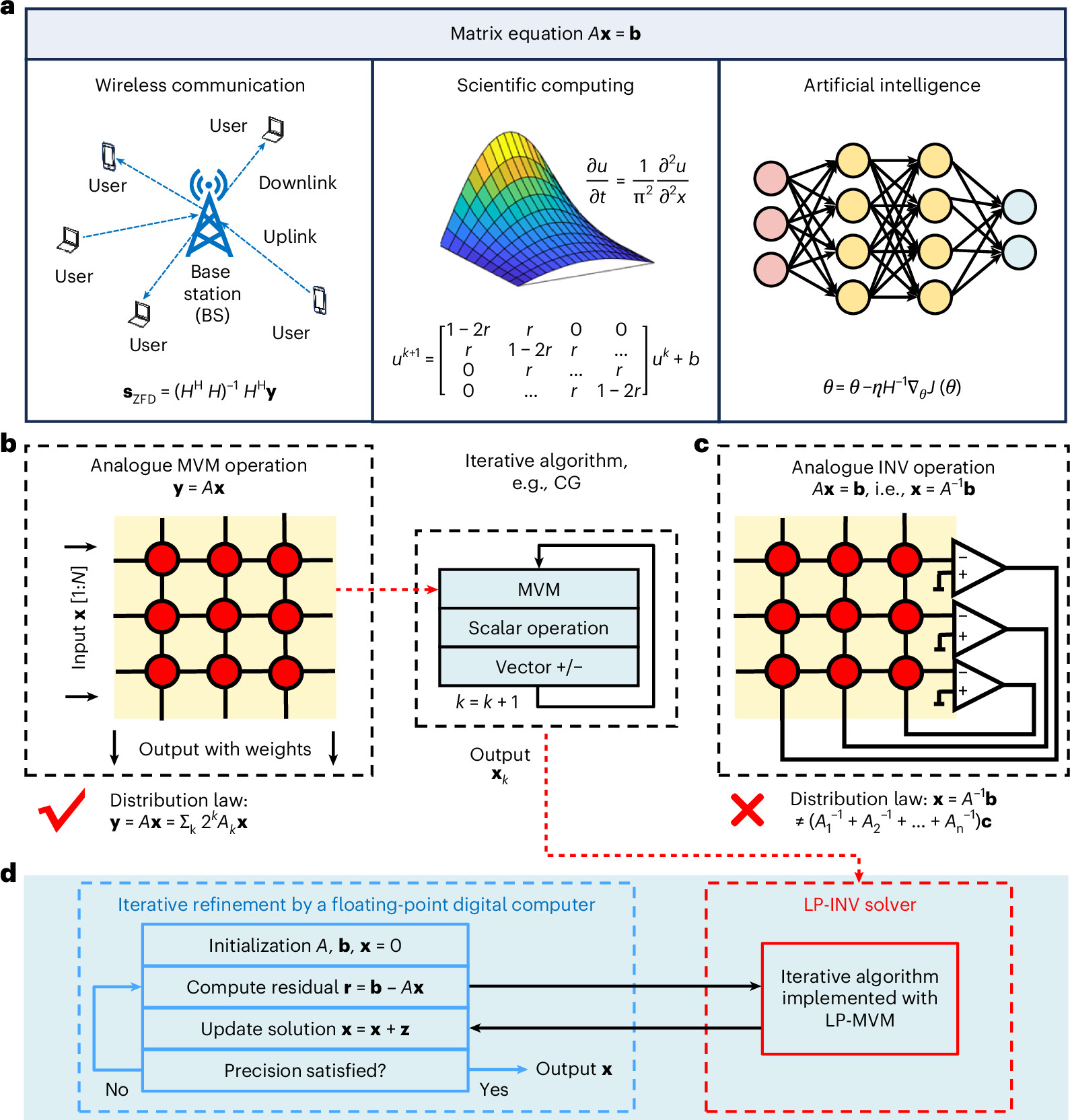
Figure 1 from Zuo, Wang, Luo et al., Nature Electronics (13 October 2025), doi:10.1038/s41928-025-01477-0, open access. Panel (d) is the point overseas engineers should not skip: the published precision path uses iterative refinement with a low-precision analogue solver. That is a different claim from AX100’s “one step, no iteration” product wording*.
Science and Technology Daily also summarized the 2025 paper as taking analogue precision from about one percent to the 10−7 range, and as being three orders of magnitude faster and two orders more energy-efficient than an advanced GPU*. Some of that is the paper’s own framing; some of it sits next to earlier Sun-group work (including a 2019 PNAS demonstration that was around 3% relative error on a 3×3 array). We are not collapsing those numbers into a single AX100 spec.
Sun is described in November Chinese coverage as a researcher at PKU’s AI institute and, in earlier interviews, as slated to be Anatrix’s chief scientist. The company is commercializing the line of work; that does not make the 16×16 paper a drop-in validation of every November 15 bullet.
The September preview: two engineering samples were due back
On September 20, 2026, Anatrix appeared at the Global AI Chip Summit in Shanghai. The company’s own news post says Sun joined a roundtable and Xiang spoke on the main stage, and that Anatrix announced two engineering samples were about to come back from the fab, with comprehensive testing and task validation to follow. The October tape-out / November readout is the first public follow-up to that preview. The second sample has not been named in the November 15 coverage we saw.

Official Anatrix photograph of CEO Xiang Rui at the 2026 Global AI Chip Summit in Shanghai, from the company’s September 20, 2026 news post. The slide reads “现代模拟计算:下一代AI的芯跳” — modern analog computing as the “heartbeat” of next-generation AI.
Not as a part you can order. We found no public datasheet, evaluation board, process node, official maximum matrix size, or Digi-Key / Mouser / Arrow listing. The November 15 story is a tape-out and a company test readout. If you want a part, the public door is the company itself: anatrix.com and [email protected] (the address on the site footer; the legal line is “© Anatrix, Inc.,” with Beijing ICP filing 京ICP备2026050900号). Analog-compute startups in the US and Europe (the Chinese coverage itself name-checks IBM Research, and names such as Unconventional AI and Normal Computing) are the competitive context an overseas buyer will compare against — we did not independently benchmark AX100 against any of them.
What would have to be true for this to matter
The reason to watch the chip, rather than shrug at another analog-compute press note, is the combination of a packaged, labeled part, a one-step / constant-time product claim, and a peer-reviewed precision path in the same research group. If a production AX100 can accept a usefully large A, return an accurate x, and do it without the I/O and conversion overhead eating the 100 ns, it would be relevant to real-time robot control, large MIMO, and second-order training updates — the three buckets the company already chose to test*.
The reason to wait is equally concrete. Analog compute’s historical failure mode is not “it never works in a paper,” it is “the error, the array size, the data movement, and the software never quite become a product.” AX100 is at the engineering-sample stage. Xiang’s “overtaking on a new road” (开道超车) line in the official report is a strategy slogan, not a shipping date. For now, the useful overseas-reader takeaway is narrower: a Chinese team has taped out a fully integrated analog Ax = b chip, published a first set of company numbers, and is asking to be compared with GPUs and digital ASICs on matrix solves — with the measurement details still sitting behind the company’s door.