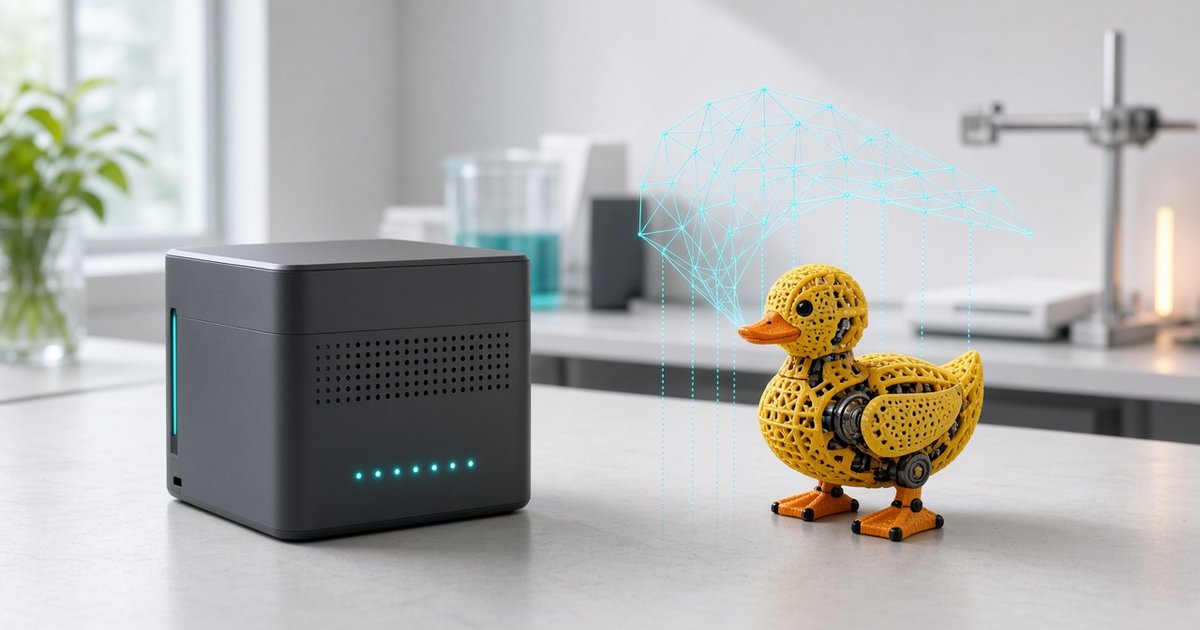
Robot learning still defaults to “train in the cloud, pray the sim transfers.” Nvidia’s GTC Microduck demos leaned on cloud GPUs; Iluvatar’s claim at the Shanghai open day is the opposite pitch: an early domestic edge product that can keep MuJoCo-Warp physics and policy loops on the desk*. If that holds beyond a staged demo, the interesting change is not another TOPS slide — it is whether a China edge box can close the sim→policy→action loop without shipping every frame to a cluster. For labs that already live inside Chinese OEM supply chains, that is a deployability question; for everyone else, it is a signal about where edge GPU software stacks are being forced to mature.
TY1200 — dense TOPS, not sparse peak*
TY1200 is rated at 300 TOPS dense (稠密) compute* — the company stresses dense, not sparse peak marketing*. That framing matters for anyone comparing China edge SKUs to Jetson / Thor class parts: sparse peaks inflate charts; dense rating is closer to what sustained physics and LLM decode actually feel like. The Tongyang (彤央) line is described as 「1 ecosystem + 2 form factors + 5 SKUs」* — modules for R&D plus plug-and-play terminals*. TY1000 already shows up in a robot-dog face-follow local demo*; TY2000 is previewed as next-gen ~600T dense*.
TY1200 is a China edge / OEM terminal story — not Digi-Key, not a Western retail board, not an AWS/GCP instance. Access path today is partner deployments and Iluvatar’s Tongyang stack inside China*; overseas engineers should treat benches and demos as vendor claims* until a channel SKU and third-party measurements appear.
Editorial still in the same desk-lab palette. LLM/VLM/Cosmos ratios and deployment numbers below are vendor / press figures*.
Vendor benches vs Nvidia Thor T5000*
Iluvatar published head-to-heads against Nvidia Thor T5000*. Treat every ratio as first-party*. On LLMs: Qwen3.8-27B / Qwen3.6-35B-A3B ~1.2× overall*; Qwen3.8-27B-AWQ generation throughput 1.38×*; Qwen3.6-35B-A3B-AWQ 1.10×*. On VLMs: Qwen2.5-VL-3B-Instruct 1.80×* (BS32 1.18×*). Cosmos-R2-2B at 158%* and Cosmos-R2-8B at 180%* of Thor T5000*. A live same-prompt demo cited TTFT 0.223 s vs Thor 0.411 s* and 30.21 tok/s vs 24.46 tok/s*. Vendor attribution: higher memory bandwidth + more compute cores*. Separately, a MiniMax open video model ran locally in ~6 minutes for a 1056×608 / 5 s clip* — useful as a local-gen latency anecdote, not a standardized bench.
Software story and 「算力分层」*
Product messaging is 「算力分层 / compute layering」 plus 「端云同源」: train in cloud, deploy on edge, re-judge in cloud*. Tongyang PM 宋远盈 Song Yuanying* walks that loop. Software stack branding is 「用AI开发AI」: FlyDSL + an agentic kernel path*; claims include PD deploy <10 min* and optimize cycles from 7 days → 2 hours*. Those are vendor productivity claims* — asterisk hard; no independent audit here.
Deployments cited*
Press lists verticals*: Hohai University JinTan battery lab vertical agent producing reports in ~2 minutes*; Shanghai Sunshine Rehab companion robot for the visually impaired*; museum day-guide / night CV train*; emergency CV + multimodal smoke detection accuracy from 70% → 95%* (vendor). TY1200 also took a 2026 CIIF 工博会国芯展创新成果奖*. Design-wins and award plaques are real marketing signals; they are not substitute for open benches or export SKUs.
What changes — and what does not
For overseas robotics / edge engineers, the watch item is whether MuJoCo-Warp-class physics and mid-size Qwen/Cosmos workloads stay local on a China-made desk box with usable software (FlyDSL / agentic kernel), not whether another 300 TOPS sticker appears. The Tongyang framing — modules for R&D plus plug-and-play terminals* — is trying to sell a product line, not a single open-day demo. Contrast stays important: Tiangai 300 is the cloud/datacenter GPU narrative; TY1200 is the edge terminal that claims to close robot sim+train on-prem*. Today’s Zhizi optical seed and Lingchuan SL200 video-SoC posts sit in different layers of the stack.
- Not Digi-Key / not Western retail — China OEM / partner path*; no Western catalog SKU this week.
- 300 TOPS dense* — vendor rating; not sparse peak marketing*.
- ~1.2× Thor T5000* (Qwen overall) / TTFT 0.223s vs 0.411s* — first-party benches*; wait for third parties.
- MicroDuck offline MuJoCo-Warp + policy train* — open-day demo claim*; contrast Nvidia GTC cloud Microduck framing.
- TY2000 ~600T dense* previewed*; TY1000 robot-dog face-follow* already in the line story.
- Distinct from Tiangai 300 — Nov 2 cloud GPU post; this evening pack is the edge terminal.
Bottom line: Iluvatar is pitching Tongyang TY1200 as a desk-side edge box that can keep physics sim and mid-size multimodal workloads offline — MicroDuck walk/stand as the showpiece*, dense 300 TOPS* and Thor-relative benches* as the spreadsheet. Asterisk the ratios and the deployment percentages; watch whether FlyDSL and partner terminals make the loop reproducible outside a media open day.